Play: A stage for life, a stage for care
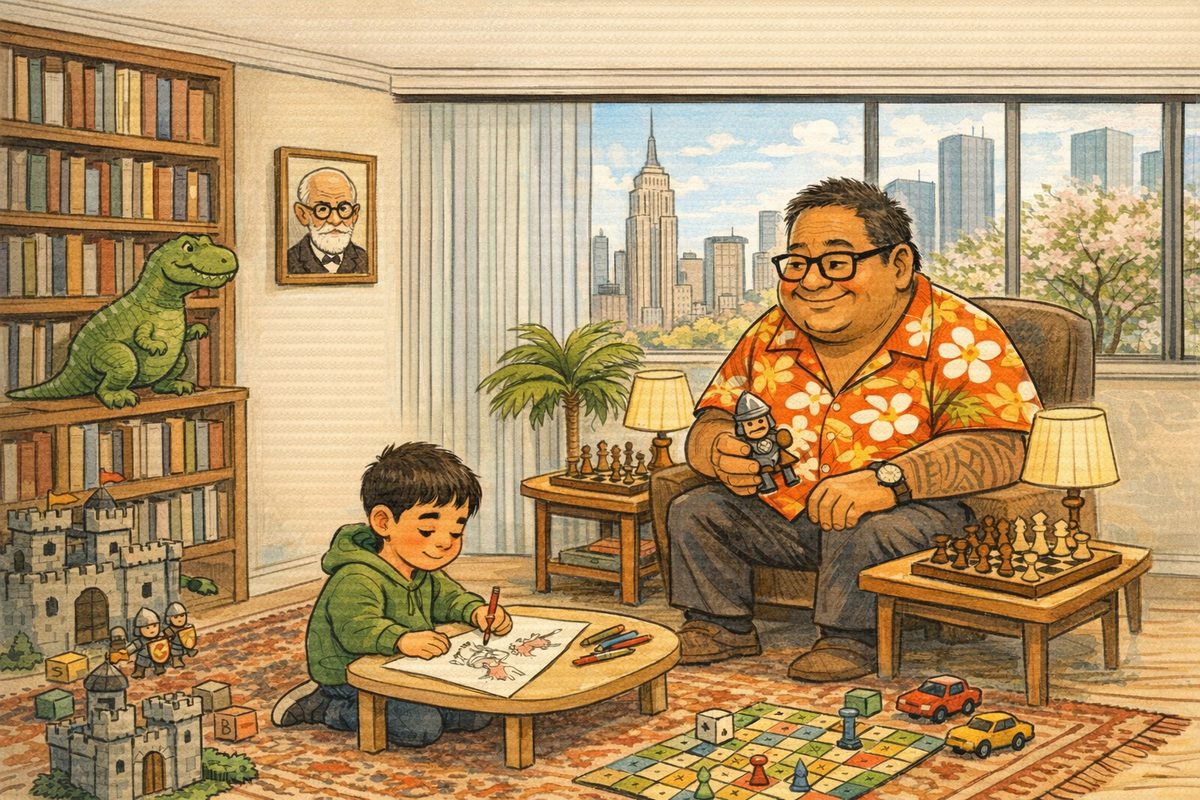
In a child consultation, play is the first language. Before words, before narratives, before diagnoses, there is gesture, gaze, repetition, staging. Play is the royal road to the child’s unconscious, but also to their vitality. It is the place where thought is built from the body, where the inner world is projected into the outer world. In this space, the therapist does not play to entertain; he plays to listen. He plays to translate, to contain, to offer the child a space where they can lay down what they cannot yet say. He plays so that the child can think without being alone.
Winnicott said that play is the space where the self comes into being. Dolto reminded us that the child is always speaking, even when they are not yet speaking. Stern saw in play an intersubjective space where the child experiences that they exist in the other’s gaze. Goldman, in her clinical work, showed that play is a place of symbolic repair. And Bion, observing traumatized children, understood that play transforms the unthinkable into something that can be thought. Play is therefore an act of mental health, an act of creation, an act of survival.
Play begins long before toys. It is born in an old bunch of keys that jingle like a secret, in a cardboard box that becomes a house, a boat, a cave, in a small basin where water splashes like an entire world, in a treasure box where the child slips a stone, a feather, a subway ticket, a button found on the ground. Anthropologists have shown it: wherever there is a child, there is play. Among the Inuit, babies play with polished bones. Among the Dogon, children make figurines out of red earth. In Chinese hutongs, little ones play with tea lids. Among Australian Aboriginal peoples, children imitate animals to learn how to read the world. Play is a universal language, a breath shared by all humanity.
Very young children play with what they find, what shines, what rolls, what opens and closes. A baby can spend twenty minutes dropping a bunch of keys from a chair, again and again, to check that the world obeys a law. Another fills and empties a basin, as if learning the breathing of the world. These simple games build thought, permanence, trust. They are the first laboratories of reality. The comfort object appears as a first companion. Winnicott called it a transitional object. It smells of milk, night, fear and comfort. It is a portable piece of mother, a bridge between inside and outside. A child can hold it tight like one holds a border. It is the first other that the child can love without being engulfed.
Later, games become scenes. The toy kitchen is a miniature theatre where the child learns to feed and be fed, to give, to refuse, to spill, to repair. One day, a little girl spent twenty minutes pouring water from one cup to another, as focused as a surgeon. She was repeating a gesture she did not yet dare to perform in real life. Play is a dress rehearsal for reality, a discreet training, a way of appropriating the world. Chinese clinicians from the Hangzhou school describe these games as practices of harmonization, where the child adjusts their breath to the world.
Dolls are sometimes washed, sewn up, tucked in. A child once symbolically sewed the leg of a cloth doll while whispering, “It’s going to be okay now.” She was speaking about herself. Goldman has often shown this: the child repairs the other in order to repair themselves. Fraiberg, in the United States, said that play is a place where family ghosts can be tamed.
Little cars roll, crash, line up. They allow the child to explore speed, control, collision, mastery. A little boy lined up his cars by color, size, brand. It was his way of putting order into a chaotic inner world. Cars are bodies, trajectories, miniature destinies. Kestenberg would have spoken here of motor rhythms that organize psychic life.
Collections of cards, stones, figurines are attempts at mastery. They reassure. They give a sense of continuity. They allow the child to say: this world is vast, but I can own a piece of it. An obsessive child brought his stone collection every week. He sorted them, resorted them, counted them again. It was his ritual to stay upright.
Puzzles teach how to tolerate the unfinished. They show that the whole is built piece by piece. An anxious child breathed more easily as he placed each piece. Every piece found was a victory over chaos. Piaget would have said that the child constructs reality as they construct a puzzle.
Board game such as Uno, Memory, other table game, support frustration tolerance, rule-following, and mentalization as described by Fonagy. A child who accepts losing a game of Uno learns to lose a bit of control without losing their integrity. The game of categories (similar to “Scattergories” or “baccalauréat”) beyond knowledge, supports mental flexibility, speed of association, creativity. It shows how the child thinks under pressure, how they organize their ideas.
Some children draw wars, explosions, tanks, even though they have never seen war. They draw their internal conflicts, their fears of collapse, their archaic anxieties. A five-year-old child drew battles every week. One day, he drew a soldier laying down his weapon. He had found a way out. Meltzer would have spoken here of aesthetic conflict and transformation, the moment when thought finds a form.
Adolescents play differently. Their play shifts toward chess, video games, sports challenges, painting, writing. In chess, an adolescent learns to anticipate, to give up, to lose a piece to save the game. It is a metaphor for life. Painting becomes a refuge. An adolescent painted faceless silhouettes for months. Then one day, a face appeared. He had found a form to express his loneliness. Native American clinicians speak of such practices as vision paths, where the adolescent seeks their own inner territory.
In the consulting room, the therapist plays with the child to listen to what is said in gesture, repetition, staging. He does not play for the sake of play. He plays to understand. He plays to offer a space where the child can lay down what they cannot yet say. He plays to contain, to translate, to transform. He plays so that the child can think without being alone. Winnicott said that the therapist must be where the child plays, neither too close nor too far.
And for parents, there is never any need to force themselves. Play does not need to be perfect, constant, or educational. It needs to be alive. It needs a bit of time, a bit of availability, a bit of gaze. Above all, it must not be over-stimulated. A child must be bored in order to invent. They need emptiness to create. They need time to find their own games. Indigenous peoples of the Amazon let children play for hours without intervening, convinced that play is a way of weaving the soul.
Play is essential to the child’s mental health. It is a space of growth, repair, symbolization. It is a place where the child can speak without words, repair without collapsing, create without being judged, think without being alone. Play releases a speech that the child cannot yet pronounce. It opens a space where we can, together, repair the world: one car, one Lego, one nursery rhyme, one blanket fort at a time.
References
Anzieu, D. (1985). Le Moi-peau [The skin-ego]. Paris, France: Dunod.
Bion, W. R. (1962). Learning from experience. London, UK: Heinemann.
Dolto, F. (1985). La cause des enfants [The cause of children]. Paris, France: Gallimard.
Fonagy, P., & Target, M. (2002). Affect regulation, mentalization and the development of the self. New York, NY: Other Press.
Fraiberg, S. (1980). Clinical studies in infant mental health. New York, NY: Basic Books.
Goldman, D. (1998). Travaux cliniques sur le jeu et la symbolisation [Clinical works on play and symbolization]. Paris, France: PUF.
Greenspan, S. I. (1997). The growth of the mind and the endangered origins of intelligence. Reading, MA: Addison-Wesley.
Kestenberg, J. S. (1975). Children and parents: Psychoanalytic studies in development. New York, NY: Jason Aronson.
Meltzer, D. (1988). The apprehension of beauty: The role of aesthetic conflict in development, art and violence. Perthshire, Scotland: Clunie Press.
Piaget, J. (1937). La construction du réel chez l’enfant [The construction of reality in the child]. Neuchâtel, Switzerland: Delachaux & Niestlé.
Stern, D. N. (1985). The interpersonal world of the infant. New York, NY: Basic Books.
Winnicott, D. W. (1971). Playing and reality. London, UK: Tavistock.