Heritage and Transmission: when light cannot be passed on
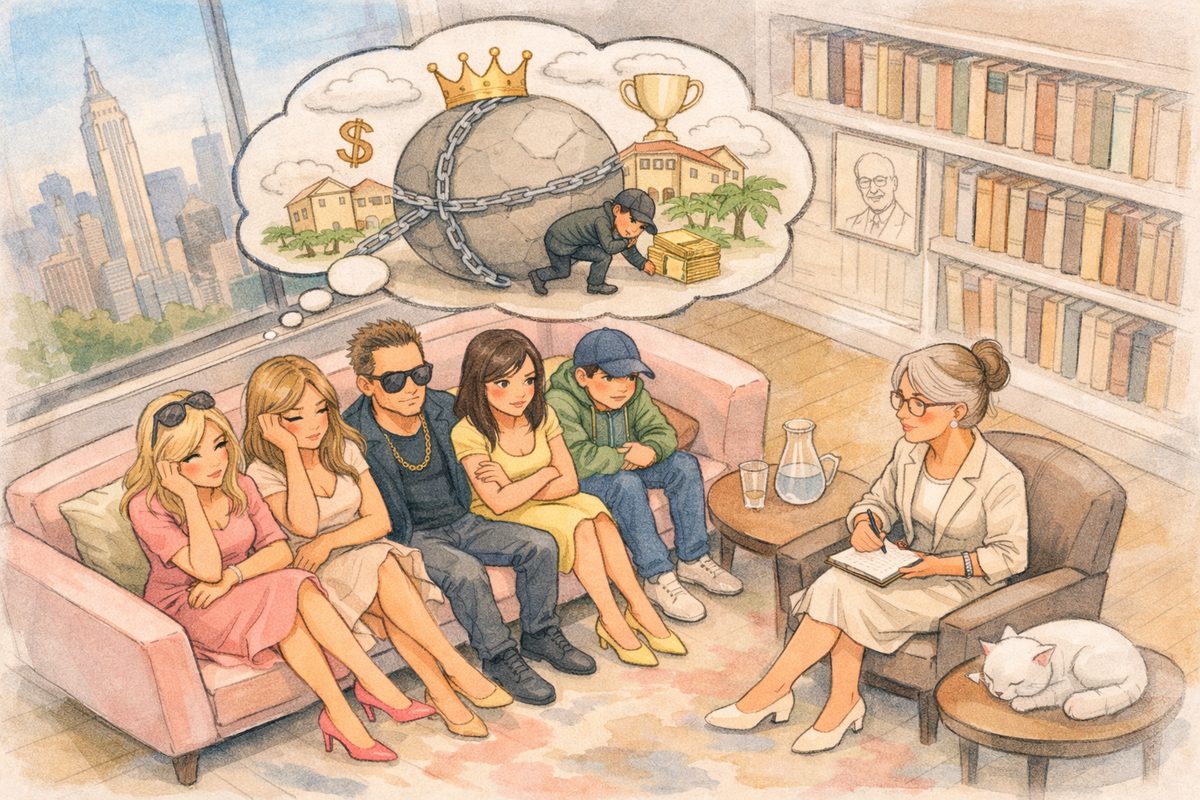
Some families transmit less a lineage than an initiation. In those where a parent becomes a public figure, a living empire, a symbol more than a human being, the child is born into a narrative that is not their own. They are asked to inhabit a scenery built before them, sometimes even against them. Whether the parent is an industrial leader, a celebrated artist, a charismatic head of state, a member of a royal dynasty or an entrepreneur turned myth, the inner mechanism remains the same: the parent’s power creates a gravity that attracts, shapes, crushes, distorts.
Children of such figures learn early that love may be conditional, loyalty tested, visibility dangerous. Some are pushed to follow the predetermined path, others to flee it to avoid being consumed. In families where success has become a collective identity, the individual ceases to be a subject and becomes a role. Clinicians speak of narcissistic transmission, family mandates, invisible loyalties, and group psychoanalysis describes these dynamics as non-negotiated psychic inheritances: the child becomes the extension of a parental dream or the container of an anxiety the parent never managed to symbolize. These ideas, found in Bowen, Boszormenyi-Nagy, Kaës or Winnicott, illuminate how such families shape destinies.
This dynamic is not confined to clinical settings; it is also visible in contemporary culture, where some families display openly what others hide fiercely. The Kardashian family, whose therapy sessions have been broadcast, embodies the tension between intimacy and spectacle, between personal vulnerability and collective brand. The Murdoch family, portrayed in investigative documentaries, illustrates how succession can become a psychological battleground as much as a strategic one. Other public lineages, whether artistic, political or media-based, reveal how visibility can become a gilded cage in which the child must learn to breathe under the world’s gaze.
In artistic families, the stage may become the only place where the parent truly exists. The child must then choose: step into the light to be seen, or remain in the shadows to be free. In families of leaders, succession becomes a silent battlefield where every gesture is interpreted as a stance. In royal families, birth itself is a political act. In entrepreneurial families, the company becomes a third parent—demanding, jealous, omnipresent.
The trajectories of these heirs show that the issue is never merely material or strategic. It is a question of identity. How does one build oneself when everything around is already built. How does one breathe when the air is saturated with expectations. How does one exist when one’s first name is already a symbol.
In such contexts, therapy is neither luxury nor performance tool. It is a space of psychic survival. The work of McGoldrick, Bowen, Boszormenyi-Nagy, Kaës and Winnicott reminds us that powerful families do not suffer from leadership problems but from differentiation problems. Coaching teaches how to play a role; therapy helps understand why one plays it, and whether one still wishes to.
In economic, artistic or symbolic dynasties, suffering often arises from the confusion between family and institution. A family is not a company. A family is not a kingdom. A family is not a brand. Once it becomes something to optimize, protect or monetize, it ceases to be a place of attachment and becomes a place of control. Children lose the right to error, ambivalence, slowness, uselessness. They become emotional assets.
Therapy restores breath where everything is frozen. It redraws the contours of the individual, separates the I from the we, and reveals that inheritance is not a debt but a material. It helps recognize invisible loyalties, name transgenerational wounds, accept that one will not heal a parent’s pain by succeeding more. It also allows renunciation: renouncing being the perfect child, the ideal successor, the sole bearer of a story that began before oneself.
In these families, to shine does not mean to surpass the parent nor to break away violently. To shine means finding a light that does not depend on the family spotlight. A light that does not dim when the parent enters the room. A light that cannot be measured in titles, shares, roles or public appearances. A quiet, steady inner light that does not ask permission to exist.
Therapy does not promise to resolve succession conflicts, soothe rivalries or repair childhood wounds. It offers something more radical: the possibility of becoming a subject in a story where one had only been a character.
References
Bowen, M. (1978). Family Therapy in Clinical Practice.
Boszormenyi-Nagy, I., & Spark, G. (1973). Invisible Loyalties.
Kaës, R. (2009). Les alliances inconscientes.
McGoldrick, M., Gerson, R., & Petry, S. (2008). Genograms: Assessment and Intervention.
Winnicott, D. W. (1965). The Maturational Processes and the Facilitating Environment.