Moving House: A Traversal of the Psyche
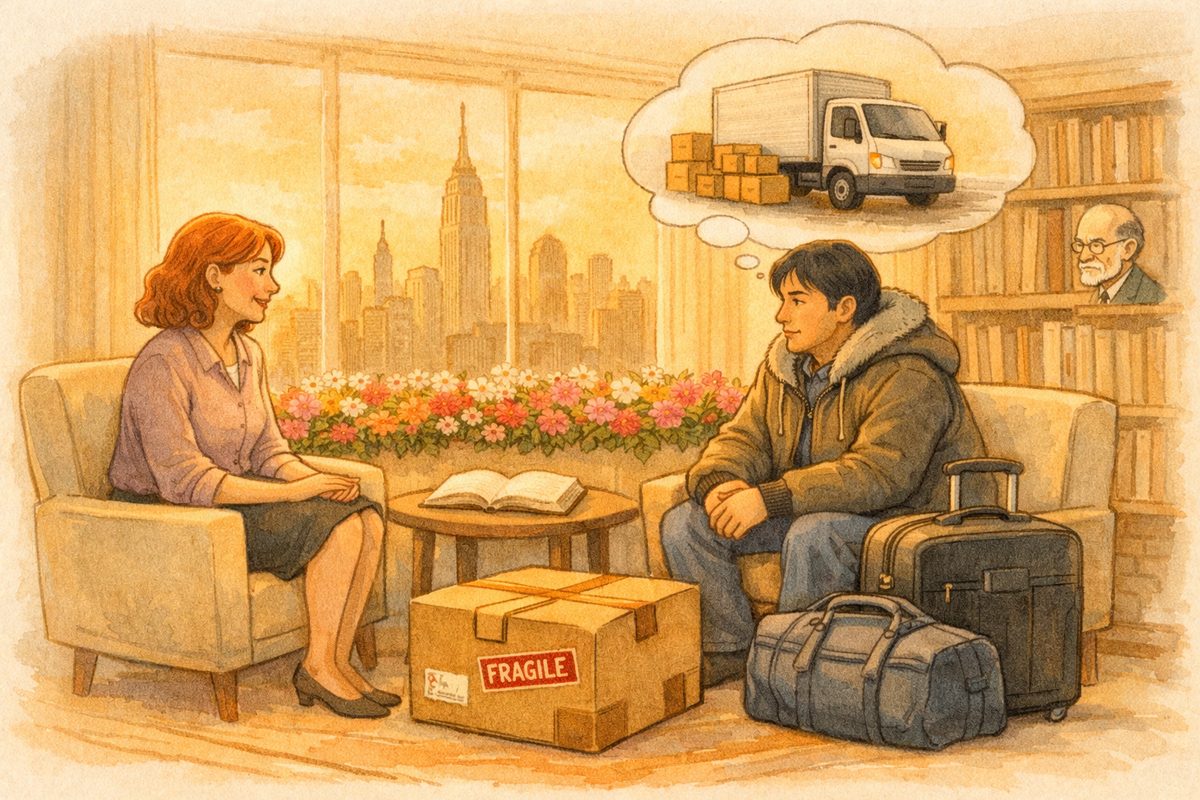
Moving house is never a neutral act. We imagine we are transporting furniture, boxes, habits, but an entire portion of the psychic life is being set in motion. Changing cities, jobs, friends, sometimes language or climate, means accepting that a part of oneself will loosen so that another part may emerge. Moving is a transition, a molt, sometimes a tremor. It engages the subject in a work of separation and reinvestment that far exceeds the material logistics. Freud reminded us that ‘human beings never relinquish what is familiar without resistance’: this resistance reveals that the place we inhabit is not a backdrop but a psychic envelope, a space where the self stretches, deposits itself, protects itself.
The inhabited place functions like a symbolic skin. Didier Anzieu formulated it with remarkable precision: ‘The skin‑ego is a representation of the ego as container of psychic life.’ Leaving a place means losing a skin, having to fabricate a new one. The walls, the smells, the light, the daily routes, the familiar voices -all of these form a membrane that supports identity. When this membrane tears, even voluntarily, the subject finds themselves momentarily exposed. They must rebuild sensory, emotional, relational landmarks. They must relearn how to inhabit.
For adults, this work is often silent. We speak of fatigue, stress, overload, but what unfolds is deeper: a temporary narcissistic disorganization. The frame that supported the image of oneself dissolves. One must reinvent oneself in a new environment, rediscover a place, a way of being seen, a way of feeling real. Bowlby’s work on attachment shows that spatial stability supports internal security; its loss can provoke a discreet regression, an increased vulnerability, an unusual sensitivity. Yet moving can also be a rebirth: a space where one sheds old identifications, where one surprises oneself by breathing differently, thinking differently. Some patients describe this moment as an ‘inner deviation’: a shift in the gaze upon oneself, a possibility of beginning again without erasing.
For children, moving is a more raw experience. The young child loses sensory landmarks: the bedroom, the school, the voices, the smells. They lose the symbolic frame that allowed them to feel contained. Winnicott spoke of the importance of a ‘good‑enough environment’: the place, like the relationship, must offer continuity so that the transition is not lived as a collapse. The school‑age child experiences the loss of friends as a rupture in belonging. They must rebuild their place in the group, relearn the codes, alliances, rivalries. The adolescent may experience moving as a narcissistic blow or an exile. They lose the territory where they had begun to differentiate. They must once again present themselves to the world, sometimes with painful intensity.
The entire family is engaged in this traversal. Moving is never individual: it shifts bonds, roles, balances. René Kaës speaks of the ‘unconscious link’ that unites members of a group: when the place changes, this link must reorganize. Parents must contain their own anxieties so as not to transmit them. Children perceive everything: tensions, hesitations, hopes. The place becomes the support of a collective fantasy - that of a new beginning, a repair, a promise. But it can also become the stage of a repetition: what one flees may replay itself elsewhere, under another light.
The molt is an ambivalent process. It implies loss, but also creation. It requires tolerating emptiness, the unknown, the temporary absence of landmarks. Roussillon speaks of the ‘work of the link’: one must re‑articulate internal and external landmarks so that the transition becomes an act of subjectivation. Moving, in this perspective, is not a flight but a traversal. It tests the subject’s capacity to move within their inner world as much as in the outer world. It forces recognition of what one carries, what one abandons, what one transforms.
To inhabit is to be. The place is not a simple space but a part of the self. Moving means accepting that this part will shift, loosen, reinvent itself. It is an ordeal, but also an opportunity: the chance to meet oneself differently, in a new space, still under construction. The transition can become an act of freedom, a movement toward oneself, a way of making one’s inner world more habitable. Moving is not merely a change of address: it is a change of psychic skin, a molt that engages the subject in a deep, sometimes discreet, sometimes unsettling, always transformative work.
References
Anzieu, D. (1985). Le Moi‑peau. Dunod.
Bowlby, J. (1988). A Secure Base: Parent‑Child Attachment and Healthy Human Development. Basic Books.
Brown, G. W., & Harris, T. (1978). Social Origins of Depression. Free Press.
Freud, S. (1926). Inhibition, symptôme et angoisse. Payot.
Holmes, T. H., & Rahe, R. H. (1967). The Social Readjustment Rating Scale. Journal of Psychosomatic Research, 11(2), 213–218.
Kaës, R. (2012). Le lien inconscient. Dunod.
Roussillon, R. (2019). Le travail du lien et la subjectivation. PUF.
Winnicott, D. W. (1965). The Maturational Processes and the Facilitating Environment. Hogarth Press.