April Fools’ Fish: A Ritual of Shared Illusion
April first slips through our calendars like a small crack in the seriousness of the world. It is a day when truth is allowed to wobble, when we play at deceiving one another in order to reconnect, when paper fish are pinned to backs as if fragments of fantasy were being fastened to the weight of everyday life. The gesture seems trivial, almost childish, yet it carries a long history, an inheritance of seasonal rites, symbolic reversals, and playful illusions.
The origin of April Fools’ fish remains uncertain, as if it delighted in eluding historians. Many point to the 1564 edict of Charles IX, which moved the start of the year to January 1st. Those who continued exchanging gifts in the spring became targets of mockery: they were offered fake presents, often fish, since it was the season of Lent. Other, older traditions link spring to festivals of renewal in which hierarchies are inverted, self‑mockery is permitted, and the world becomes a stage. Discreet, slippery, elusive, the fish, becomes the perfect emblem of consensual illusion.
Across cultures, the ritual takes different forms. In France, Belgium, and Switzerland, children tape paper fish to unsuspecting backs and invent absurd stories. In English‑speaking countries, April Fool’s Day unfolds in elaborate pranks, sometimes orchestrated by media or institutions. In Scotland, the old Hunt the Gowk sent the gullible from house to house with absurd messages. Elsewhere, other spring festivals play the same role: overturning, unsettling, re‑enchanting.
Beyond the anecdote, April Fools’ fulfills an essential social function. It creates connection: a successful prank is a tacit pact, a shared moment of laughter that binds. It reverses roles: the child becomes the agent, the adult the target, and hierarchy softens without violence. It introduces play into reality: the world becomes a little less rigid, a little more breathable. It ritualizes uncertainty: we tame the false in order to better endure the true.
Psychoanalysis sees in this ritual a privileged space where the unconscious moves freely. The pleasure of deceiving without harming allows transgressive impulses to be expressed safely. The fake gift or fake news stages absence, illusion, desire are fundamental materials of psychic life. The fish taped to one’s back speaks of the blind spot: it reminds us that we never see ourselves entirely, that the Other perceives what escapes us. Laughter, finally, acts as a discharge: it releases tension, loosens the superego, and opens a Winnicottian transitional space where illusion is not only permitted but necessary.
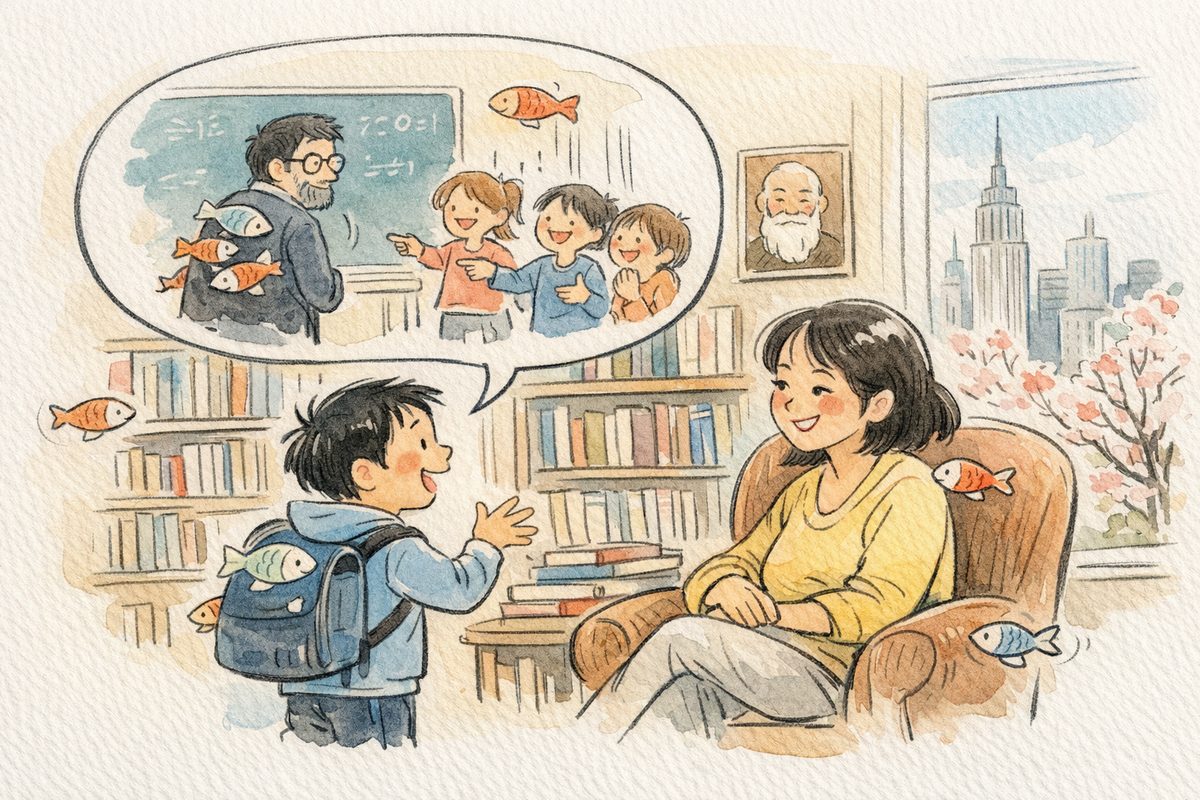
And then comes the evening scene, the one that brings theory back to life. Late in the afternoon, the door opens softly. He returns from school with that particular brightness in his eyes that children carry when they have taken part in something important, even if it is important only to them. He drops his bag, hesitates, then begins: “You’re going to laugh. Today was so funny.” In class, they had prepared the operation in secret. Fish cut out with the seriousness of artisans, bright colors, improbable shapes. The math teacher entered, absorbed in his lukewarm coffee. Then, like a flock of sparrows, the children approached. One spoke loudly to distract him, another taped the fish, a third stifled a giggle. The teacher continued his lesson, unperturbed, with a small school of fish on his back. “We decorated the classroom too,” the child adds, proud as a little conspirator of the everyday.
In this evening story, everything is there: the joy of shared secrecy, the gentle transgression, the pleasure of participating in a rite whose history he does not yet know but whose necessity he already feels. April Fools’ is not a trivial joke: it is a millennia‑old gesture, a wink at uncertainty, a way of saying that reality is not as solid as we pretend, and that this is perhaps very good news.
References
Bergson, H. (1900). Laughter: An essay on the meaning of the comic. London: Macmillan. Freud, S. (1905). Jokes and their relation to the unconscious. New York: Norton. Freud, S. (1920). Beyond the pleasure principle. New York: Dover. Le Goff, J. (1985). Time, work, and culture in the Middle Ages. Chicago: University of Chicago Press. Van Gennep, A. (1960). The rites of passage. Chicago: University of Chicago Press. (Original work published 1909)