When Silence Begins to Speak
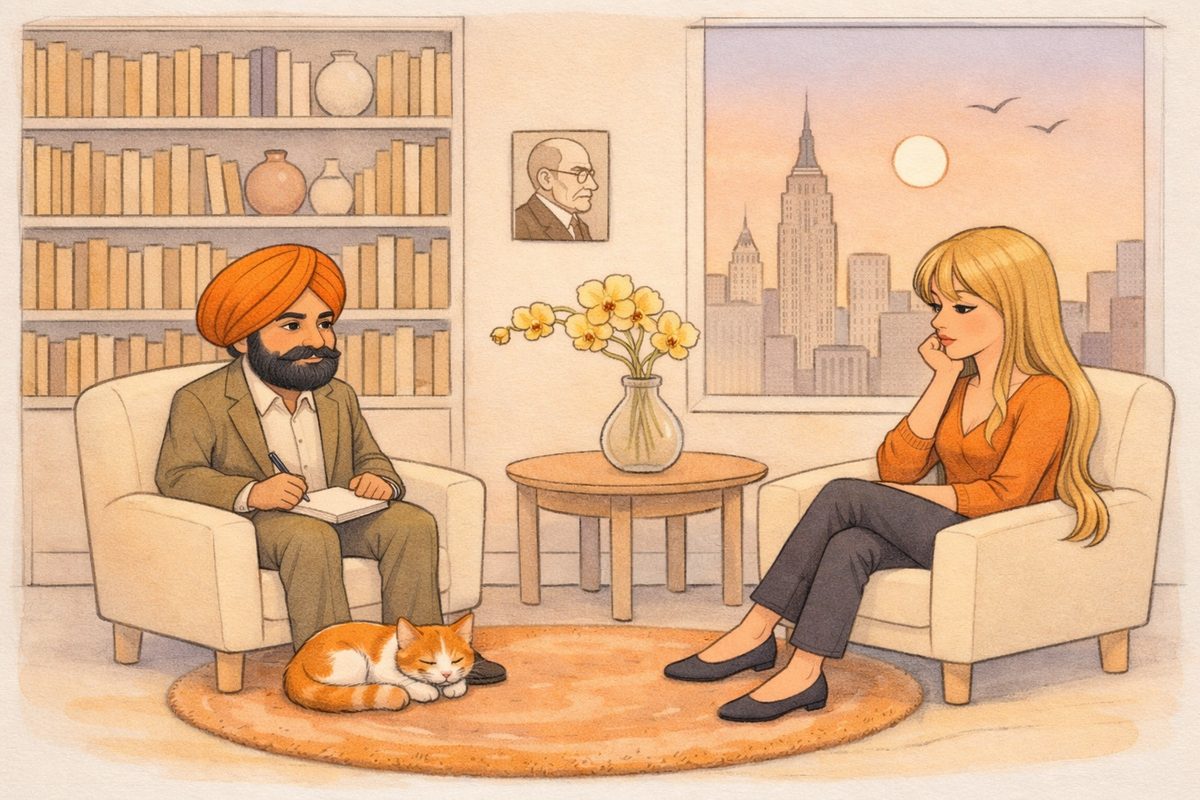
There are moments when the patient lies down and nothing comes. Silence settles into the room like a discreet visitor, almost shy, yet capable of filling all the available space. It is never a simple interval between two sentences. It is a psychic event, a sensitive material, a breath that takes shape between two bodies. Silence is not the absence of speech; it is speech turned inward, a form of language that has not yet found its words.
Some silences are soft, almost cotton‑like. They wrap the session in a light mist, as if the patient were withdrawing for a moment to gather themselves. Winnicott once wrote that the subject sometimes needs to “withdraw in order to return,” and there is, in these silences, a quality of inner wandering, a movement of self‑gathering that prepares a more truthful word. One can feel something working, slowly, beneath the surface.
Other silences are more abrupt. They fall like a curtain, a sudden blackout, a thought erased at the very moment it appears. The patient searches, hesitates, then lets go. This kind of silence is often a live refoulement, a direct attempt to protect what still burns too intensely. Bion described these moments as times when thought has not yet found its container: emotion overflows, and silence becomes a fragile dam.
There is also the silence that tests. The one addressed to the analyst without a word, like a riddle placed between them: “What will you do with me if I give you nothing?“ This silence often reenacts older scenes: a parent too intrusive, another too absent, an environment where speaking had no place. Ogden showed how such silences are primitive forms of communication, where the patient probes the solidity of the other, their capacity to remain alive, thinking, breathing, even in apparent emptiness.
For the analyst, silence is never neutral. It moves through the body, alters the rhythm of breathing, shifts the focus of attention. Some silences induce drowsiness: the patient then deposits in the analyst a sense of emptiness, withdrawal, or emotional flatness. Others irritate, awaken a subtle impatience, a desire to shake, to restart, to “make the patient talk.” Sometimes, unexpectedly, tenderness arises, a nearly maternal impulse, the wish to soothe, to wrap the silence as one would wrap a worried child. These countertransference experiences, far from being disturbances, become instruments of work. They speak of what the patient cannot yet articulate. Green reminded us that the analyst must accept being affected in order to think what is unfolding in the shared space.
Silence sometimes takes the form of absence. The patient does not come, forgets, cancels, disappears for a few weeks. This absence is an amplified silence, an enactment. It may be a flight, a punishment, a fear, a repetition. It may also be a call: “Hold me, even when I am not here.“ Absence, like silence, is a message addressed. It must be worked through like a dream, a slip, a symptom.
Within the session, silence can become a place of transformation. One senses something shifting, reorganizing, as if the patient were dreaming with open eyes. The analyst accompanies this movement without rushing it, allowing silence to breathe. Sometimes a gentle sentence is enough: “We can stay in this silence together”. Sometimes nothing is needed. Silence works for both.
Silence is not a failure. It is not a hole to be filled. It is a space to inhabit. A place where the patient listens to what rises, what resists, what trembles. A place where the analyst listens to what settles, what repeats, what seeks a form. Silence is often the moment when the analytic work is at its most alive. It is speech turned inward, a breath preparing the next sentence, a suspended beat in which the unconscious reorganizes itself. And when, after a long silence, a word finally emerges, it often carries a new density. As if the patient had crossed an inner landscape before returning to the other. Silence, then, was not an absence. It was a passage.
References
Bion, W. R. (1962). Learning from experience. London: Heinemann.
Dimitrijević, A. (2014). The silent patient: Silence as communication in psychotherapy. New York: Routledge.
Green, A. (1975). The living discourse. Paris: PUF.
Ogden, T. H. (1994). Subjects of analysis. Northvale, NJ: Jason Aronson.
Winnicott, D. W. (1958). The capacity to be alone. International Journal of Psychoanalysis, 39, 416–420.