Fire, the Psyche and the Shadow: What Burning Means
There is in fire a truth that words cannot reach, an ancient and archaic truth, almost pre‑human. Fire fascinates, frightens, attracts, repels. It is destruction and purification, threat and promise, end and beginning. Since the earliest myths, it has been the place where humans project their anxieties, desires, anger and rebirths. In clinical practice, fire is never merely physical (it becomes a language). It speaks what the subject cannot say otherwise. It reveals what burns within.
Pyromania, as defined in the DSM‑5, belongs to impulse‑control disorders. The subject feels rising tension before the act, fascination with fire, gratification at ignition, and no material or vengeful motive. Yet this definition remains insufficient. It does not express what psychoanalysis has explored for more than a century: fire as metaphor for inner conflict, as response to anxiety, as attempt to master psychic chaos. Freud already evoked the link between fire and infantile sexuality (Freud, 1908). Fenichel described the arsonist as caught between aggressive impulse and ego ideal. Kernberg illuminated these acts as attempts to restore coherence, fight inner emptiness, produce intensity that replaces absence.
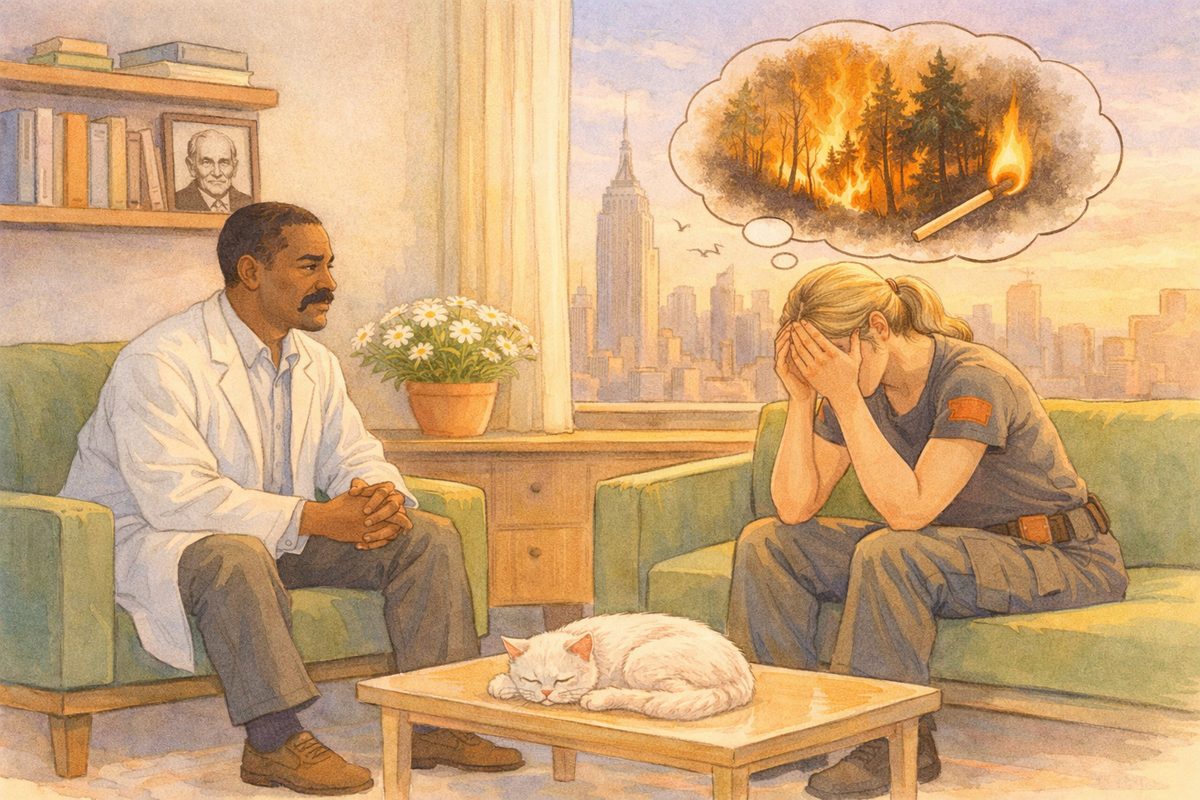
In real‑world tragedies, fire takes on symbolic dimension. When the forest of Fontainebleau burned, when more than a hundred hectares were devastated, when one suspect turned out to be a volunteer firefighter, something cracked in the collective imagination. The firefighter became the arsonist. The protector, the destroyer. The subject was caught in double identification (extinguish the fire and ignite it). Clinically, such reversals are never trivial. They express inner struggle, conflict between ideal and impulse, tension between repairing and destroying. They also reveal the fragility of those who engage their bodies in emergency professions.
International research clarifies this complexity. In the United States, Grant and Kim (2007) show associations with early trauma, depressive states, impulse‑control disorders. In the United Kingdom, Gannon and Pina (2010) describe compulsive firesetting as emotional regulation (transforming inner tension into external event). In India, Sakhardande (2019) observes links with extreme solitude, social distress, broken symbolic ties. Everywhere, fire appears as archaic language, a call, an attempt to speak differently.
Pyromania and kleptomania share a strange kinship. Two impulse‑control disorders, two gestures without material gain, two acts seeking relief from inner tension. The kleptomaniac steals to calm excitement, fill a void, feel alive in transgression. The pyromaniac lights to master anxiety, transform tension into light, feel intensity. In both cases, the object is not the goal (it becomes the medium, the language). McElroy (1992) shows a shared psychic architecture: tension, acting out, relief, shame. The kleptomaniac steals what he does not desire. The pyromaniac burns what he does not wish to destroy. Both seek a stage for their anxiety.
In literature, fire is everywhere: Achilles’ anger, Phaedra’s passion, Troy’s destruction, Dante’s purification, Prometheus’ flame, Shakespeare’s blaze, Dostoevsky’s inner fire. It consumes and reveals. It destroys and illuminates. It burns and saves. In psychoanalysis, it is drive, excitation, anger, sexuality, transformation.
To accompany an arsonist is to listen to what the fire tried to say; to hear tension before the act, solitude, shame after arrest; to understand fire as attempt at repair, mastery, transformation; to welcome guilt and work through shame; to rebuild symbolic ties where flames left ashes.
Fire is never neutral. It is language. It is call. It is attempt to survive unbearable inner tension. It is an act where the body speaks before the subject. It is a psychic blaze seeking a stage.
References
Freud, S. (1908). Character and anal erotism.
Freud, S. (1923). The Ego and the Id.
Grant, J. & Kim, S. (2007). Clinical characteristics of pyromania. Journal of Clinical Psychiatry.
Gannon, T. & Pina, A. (2010). Firesetting: A review of theory and research. Clinical Psychology Review.
Sakhardande, A. (2019). Impulse control disorders in Indian clinical populations. Indian Journal of Psychiatry.
McElroy, S. (1992). Impulse control disorders: Clinical and theoretical perspectives. American Journal of Psychiatry.