The Inner Sea: Psychoanalysis and Sailors
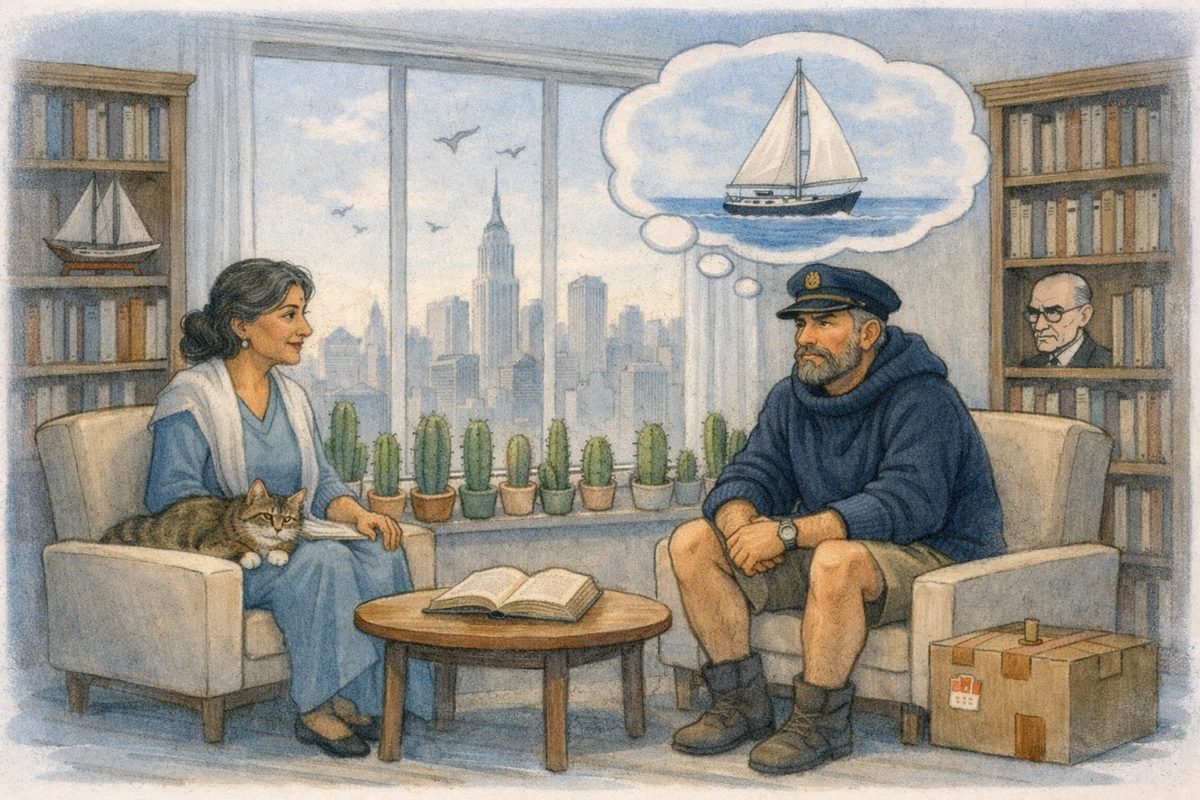
There is something in a sailor’s solitude that speaks directly to the unconscious. The one who goes to sea alone, a.k.a the solitary sailor, enters a space where the boundaries between inside and outside dissolve. The horizon becomes a mirror, the waves a pulsation of the psyche. In your own research on solitary sailors, you described this crossing as a psychic drift, a movement in which the inner world expands until it merges with the immensity of the ocean.
Psychoanalytic literature has long been fascinated by this encounter between the human mind and the sea. Freud evoked the oceanic feeling (that impression of limitless unity) as the trace of an infantile experience, the memory of fusion with the maternal body. Winnicott later spoke of the capacity to be alone, not as isolation but as a creative space where the self can exist without collapsing. The sailor, in this sense, embodies that capacity: alone, yet held by the rhythm of the waves, contained by the continuity of the sea as a good‑enough environment.
But solitude at sea is not always benevolent. Psychiatric and neurological studies (notably from the French Navy’s medical service to the work of researchers such as Le Scanff and Tafforin) describe the hallucinatory phenomena that arise after days of sensory monotony. Sailors hear voices in the wind, see figures on the deck, phantom lights on the horizon. These visions are not mere delusions: they express the psyche’s effort to maintain contact when the external world fades. The hallucination becomes a form of company, a projection of inner life onto emptiness.
The return to land is often more difficult than the departure. After weeks in a closed, self‑regulated universe, the sailor must re‑enter the social world, with its density, its noise, its demands. Many describe a derealization, a kind of vertigo of proximity: the land feels too solid, people too close. Psychiatrist Jean‑Pierre Bouvet, in his studies of long‑distance navigators, noted that ‘the sailor’s body continues to move when the boat has stopped.’ The inner sea persists; the rhythm of the waves remains inscribed in the nervous system.
For some, the sea is not an escape but a return to a primordial state of fluidity, to a space where thought and sensation merge. Didier Anzieu might have said that the ocean functions as a liquid skin‑ego, an envelope that protects and dissolves at once. The sailor’s immersion is both regression and rebirth: a descent into the unconscious and a re‑emergence through movement.
The departure carries a symbolic charge: casting off is separating, leaving the maternal shore, confronting the unknown. The return, conversely, confronts the limits of freedom: re‑entering the symbolic order, accepting gravity. Many sailors speak of the melancholy of arrival, the impossibility of translating the experience of the sea into terrestrial language. Lacan might have seen in this impossibility the very structure of desire: what the sailor seeks is not the sea, but the lack that the sea reveals.
Clinically, the sailor’s voyage can be read as a transitional space, akin to Winnicott’s play area, a zone between inner and outer reality where creativity and madness coexist. The boat becomes a psychic container, a floating frame that holds the self together. When this frame cracks (through exhaustion, isolation, or storm) the unconscious rises. Hallucinations, voices, visions are signs of this breach.
And yet, the sea heals. Psychophysiological studies show that the rhythmic motion of waves induces states of relaxation and altered consciousness similar to meditation. The sailor’s solitude, when not pathological, becomes a psychic purification: a way of encountering oneself stripped of social noise. The voyage becomes analysis in motion: the sailor both patient and analyst, listening to the murmurs of his own unconscious through the language of the sea.
To sail is to dream awake. To return is to awaken from the dream and discover that the land no longer fits. Psychoanalysis reminds us that every voyage repeats the first separation, the first loss, the first desire to return. The sailor’s hallucinations, melancholy, and exaltation are not pathologies but metaphors of the human condition: we are all, in some way, navigating between the real and the symbolic, between the sea and the shore.
References
Anzieu, D. (1985). Le Moi‑peau. Dunod. Bouvet, J.‑P. (1999). Psychologie du marin solitaire. Éditions de la Marine.
Freud, S. (1930). Civilization and Its Discontents. Hogarth Press.
Lacan, J. (1966). Écrits. Seuil.
Winnicott, D. W. (1958). The Capacity to Be Alone. International Journal of Psycho‑Analysis, 39, 416–420.
Roussillon, R. (2019). Le travail du lien et la subjectivation. PUF.
Le Scanff, C., & Tafforin, C. (2001). Psychological Adaptation to Extreme Environments: The Case of Solo Sailing. Aviation, Space, and Environmental Medicine, 72(4), 377–382.
Tafforin, C. (2013). Behavioral and Psychophysiological Adaptations in Long‑Distance Navigators. Acta Astronautica, 92(2), 145–152.