Sport, Football and Psychology: how the Body Engages the Psychic Life

I have often thought that the elite athlete is a tightrope walker. They advance along a line stretched between power and fragility, between ideal and collapse, between body and psyche. I have accompanied international athletes whose muscles seemed built to carry the world, yet whose inner life sometimes slipped away like a shadow. They arrived with their victories, their defeats, their injuries, but above all with what performance never says: solitude, shame, fear of no longer being the person others expect. In their words, I heard what Freud called the psychic economy, that fragile balance between drive, ideal, loss and repair (Freud, 1923).
Paris Saint‑Germain, like other clubs, has understood that performance is never only a matter of quadriceps or statistics. A team of psychologists works in the shadows, not to ‘motivate’, but to listen to what trembles. The elite athlete is a subject whose body speaks before they do. It speaks through injury, tension, collapse, through victories too heavy to carry. It speaks like the horse in Seabiscuit, that film where a broken animal regains its power because someone knew how to hear what its silence was saying. Sport is often that: a silence that screams.
Sport psychologists know that the athlete never arrives alone. They come with their childhood, their loyalties, their griefs, their ghosts. Jeammet’s work shows how the adolescent body (and the athlete remains an adolescent in their relationship to the body) is a site of conflict, revolt, reconstruction (Jeammet, 2015). Fuchs reminds us that performance is always a stage where intimate dramas are replayed (Fuchs, 2018). Kaës describes the team as a group psychic apparatus, a living organism in which each player carries a part of the collective fantasy (Kaës, 2007). Within a team, the psyche circulates like a silent rumor.
We saw this during the World Cup, when Didier Deschamps lost his mother. The mourning of a leader is never a private event. It travels through the team like a wave. Some players identify with the loss, others overinvest their role as supporters, others feel a new gravity in the coach’s words. Discourse becomes a place of affective condensation. The group reorganizes itself, quietly, around this fracture. Mourning in sport is never a simple event: it is a rewriting of the bond.
Notoriety is also a psychic ordeal. Kylian Mbappé is a contemporary example. Reliable journalistic sources (L’Équipe, Le Monde, France Info) have documented the extreme pressure that accompanies his visibility, his complex relationship to intimacy, and the difficulty of building a stable romantic life in a world where every gesture is scrutinized, interpreted, amplified. Fame is a gilded cage: it protects, it confines, it isolates. It creates a gap between the subject and the image of themselves, what Gorce describes as the narcissistic fracture of the champion (Gorce, 2020).
Other athletes have spoken openly about their psychological support. Rafael Nadal, in several interviews, evokes the importance of mental accompaniment to navigate injuries and collapses. Michael Phelps has described his depression and psychiatric treatment as a condition for survival. Serena Williams has spoken of the need for psychological support to manage media pressure. Andrés Iniesta has testified to his severe depression in a book and public interviews. Novak Djokovic has discussed his intensive mental work in sports publications and documentaries. Research by Reardon and by Schinke & Stambulova shows that the mental health of elite athletes is a major, often underestimated, sometimes taboo issue (Reardon, 2016; Schinke & Stambulova, 2019).
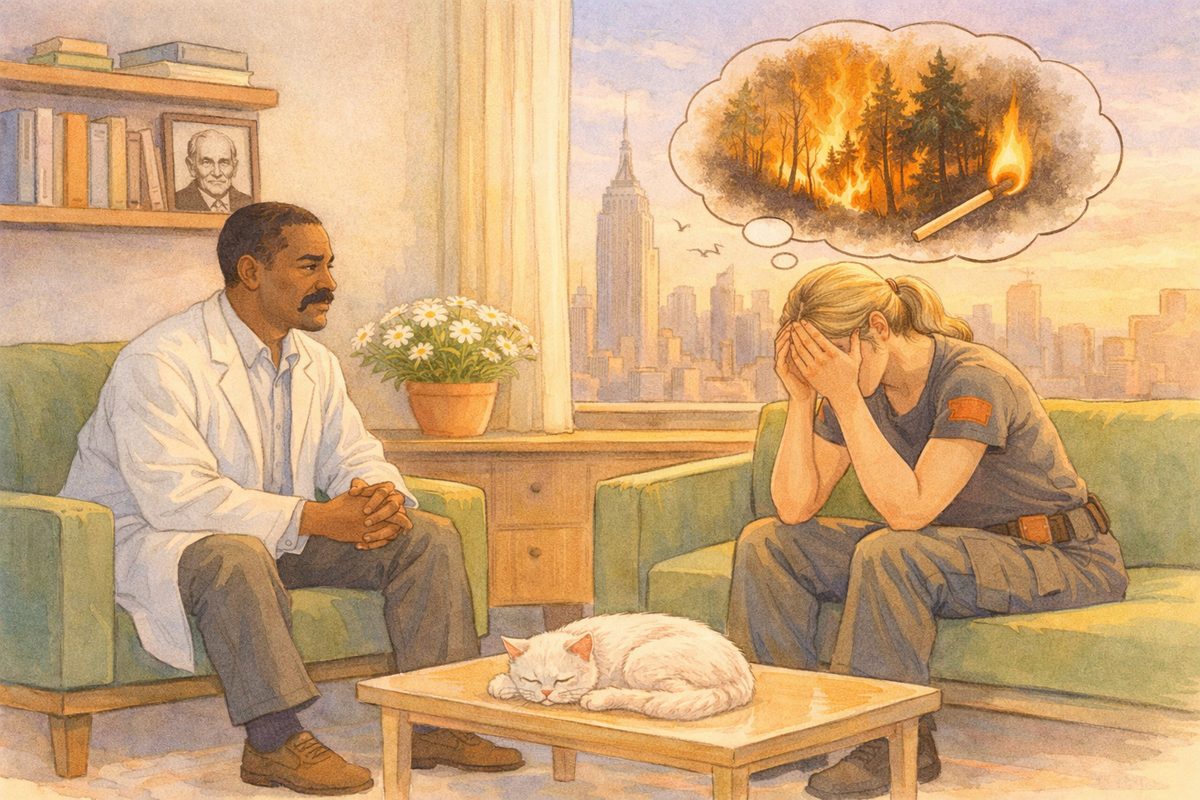
And then there are the other athletes of daily life, those who are not spoken about, those who have no stadium, no stands, no trophies. Firefighters, police officers, military personnel, first responders. They too engage their bodies as athletes do. They too live in that tension between power and fragility. They too carry an ideal that can crush them. The firefighter entering a burning building engages their body as a sprinter engages their stride. The police officer intervening in a violent situation engages their body as a goalkeeper dives for a penalty. The soldier departing on a mission engages their body as a marathon runner engages their breath. Their body is a tool, a refuge, a shield, a language. It is the place where traumas, fears, loyalties, collapses are deposited. Clinicians who accompany them know this: the body is the first site of the psyche. It is its stage, its battlefield, its refuge and sometimes its enemy.
In clinical practice, accompanying an athlete, a firefighter, a police officer, a soldier means listening to what their body says before they do. It means hearing fatigue as a message, injury as a symbol, victory as a repair, defeat as a fall of the ideal self. It means welcoming shame, that emotion so frequent among those who wear a uniform or a jersey: shame of not being good enough, shame of disappointing, shame of no longer being the person others expect. I have seen athletes cry not over defeat, but over the loss of the image they had of themselves. I have seen firefighters cry not over the intervention, but over the loss of innocence. I have seen police officers cry not over violence, but over the loss of their ideal. I have seen bodies stiffen under the weight of an impossible ideal. I have seen victories lived as burdens. I have seen injuries that were calls. And I have seen, sometimes, rebirths.
Elite sport, like professions of physical engagement, is a stage where intimate dramas are replayed. It is a place where the body carries what speech cannot always say. It is a space where the psyche seeks, through movement, a way to remain standing. And perhaps that is what we do, in the end: we accompany men and women who, in the light of stadiums or in the shadows of interventions, are simply looking for a place where their body and their soul can breathe together.
References
Freud, S. (1923). The Ego and the Id. Fuchs, F. (2018). Sports Psychology: Psychic Stakes of Performance. Dunod.
Jeammet, A. (2015). The Body at Play: Clinical Perspectives on the Adolescent Athlete. PUF.
Kaës, R. (2007). The Group and the Subject of the Group. Dunod.
Gorce, P. (2020). Sport, Body and Psyche: Clinical Perspectives. Chronique Sociale.
Reardon, C. (2016). Mental health in elite athletes. British Journal of Sports Medicine.
Schinke, R., & Stambulova, N. (2019). Athlete mental health and performance. Journal of Sport Psychology.