Suffering Bodies, Absent Speech
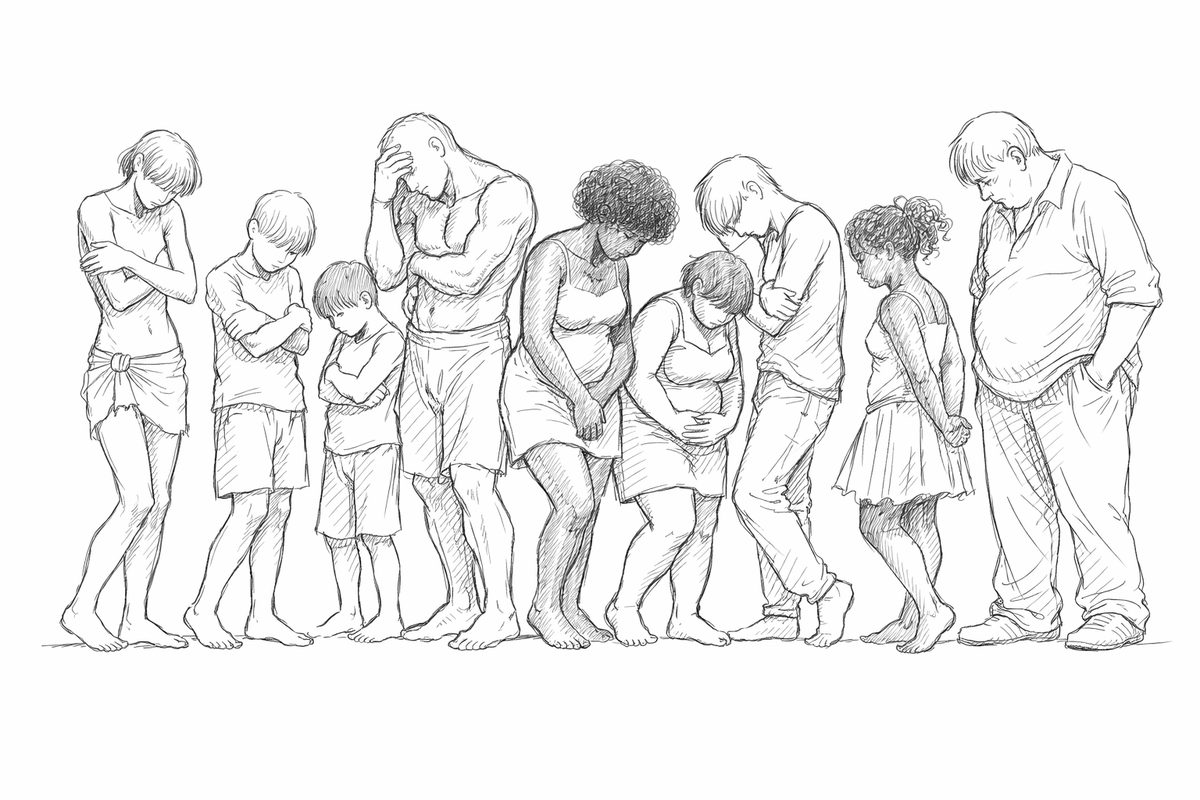
Eating disorders (anorexia, bulimia, binge‑eating disorder) raise questions that reach far beyond nutrition or one’s relationship to food. They reveal a troubled bond with the body, with self‑image, with desire, and often, with the Other.
As a clinical psychologist and psychoanalyst, I would like to offer a reading of these disorders grounded in psychoanalytic theory and in my clinical experience. The examples and names are fictional, as in my other publications. My aim is to explore how, in the midst of suffering, the body can become a form of language — a surface on which a message is inscribed when words can no longer carry it.
The issue is not what the person eats or refuses to eat, but what this behavior signifies for them. What it expresses in their place, sometimes from a buried, unspoken history? When speech is blocked or too painful to articulate, the body speaks: it reenacts, compensates, substitutes. The eating symptom becomes an attempt at representation, a way for the subject to make themselves readable where they cannot be heard.
Psychoanalysis offers tools to listen to this silent language. Freud described the symptom as a compromise between drive and repression; Lacan reminds us that “the symptom is the trace of a bodily event captured within the order of language.” It is this articulation that I wish to illuminate.
In clinical practice, the body often appears as a rampart, a surface of projection. It becomes the site of a conflict between identity, affect, and desire, and sometimes the only place where existence seems able to take shape.
As a young teenager, Anastasia comes to therapy at her mother’s request, alarmed by her extreme thinness. Intellectually gifted, she dismisses any medical concern. One sentence returns again and again: “I want to disappear without making noise.” She rejects signs of femininity, distrusts bodily transformations, and seems to seek in food restriction a form of absolute control over her body, and ultimately, over her place in the world. Analysis brings to light a fantasy of transparency, of erasure. Her emaciated body becomes the symbol of a struggle against intrusion, against sexualization, against the gaze of the Other.
Antonin, a 24‑year‑old man, seeks help after a breakup that reactivates his binge‑eating episodes. He describes the alternation of uncontrollable urges and violent purges as a form of punishment: “I fill myself up so I can hate myself afterward.” His family history reveals paternal abandonment and an overwhelmed mother. The emotional void, never verbalized in childhood, seems to have lodged itself in the body, pushing him to seek in eating a form of containment. The symptom becomes an attempt to create meaning where language could not symbolize the pain of lack.
Rachel, for her part, suffers from nighttime binge‑eating. In the first sessions, she describes her body as “an armor,” a way to make herself invisible, to protect herself from a world she perceives as threatening. Her history is marked by unprocessed traumatic events. Here, the body becomes a projection screen; the eating symptom acts as an anesthetic against an unspeakable suffering. Through the process of putting this buried experience into words (behind the excess, behind the weight) Rachel begins to reclaim her body, no longer as a barrier but as a place of existence.
These clinical examples show that an eating disorder cannot be reduced to a nutritional issue or an isolated behavior. It can be understood as a form of psychic expression where speech is lacking, as an often incomplete attempt to give shape to subjective suffering. Each patient engages in a singular relationship with the symptom, rooted in their history, representations, and internal conflicts. There is therefore no single reading of the eating symptom, but a plurality of meanings to explore.
Psychoanalysis does not aim to erase the symptom but to elaborate it. It opens a space of listening where the symptom can be narrated, linked to intimate experience, and gradually reintegrated into a process of subjectivation.
The body then shifts from being an acted‑upon object to a symbolic support. It ceases to be the exclusive site of suffering and becomes again a space of mediation, relation, and desire. The subject can thus reclaim their history, not through repetition or control, but through speech, meaning, and encounter.