When a Child Is Held by Many Invisible Arms
We often like to believe that children grow through their own inner strength, their personality, or the quality of the education they receive. Yet in clinical practice, emotional development is rarely the work of one person alone.
A child never grows up alone.
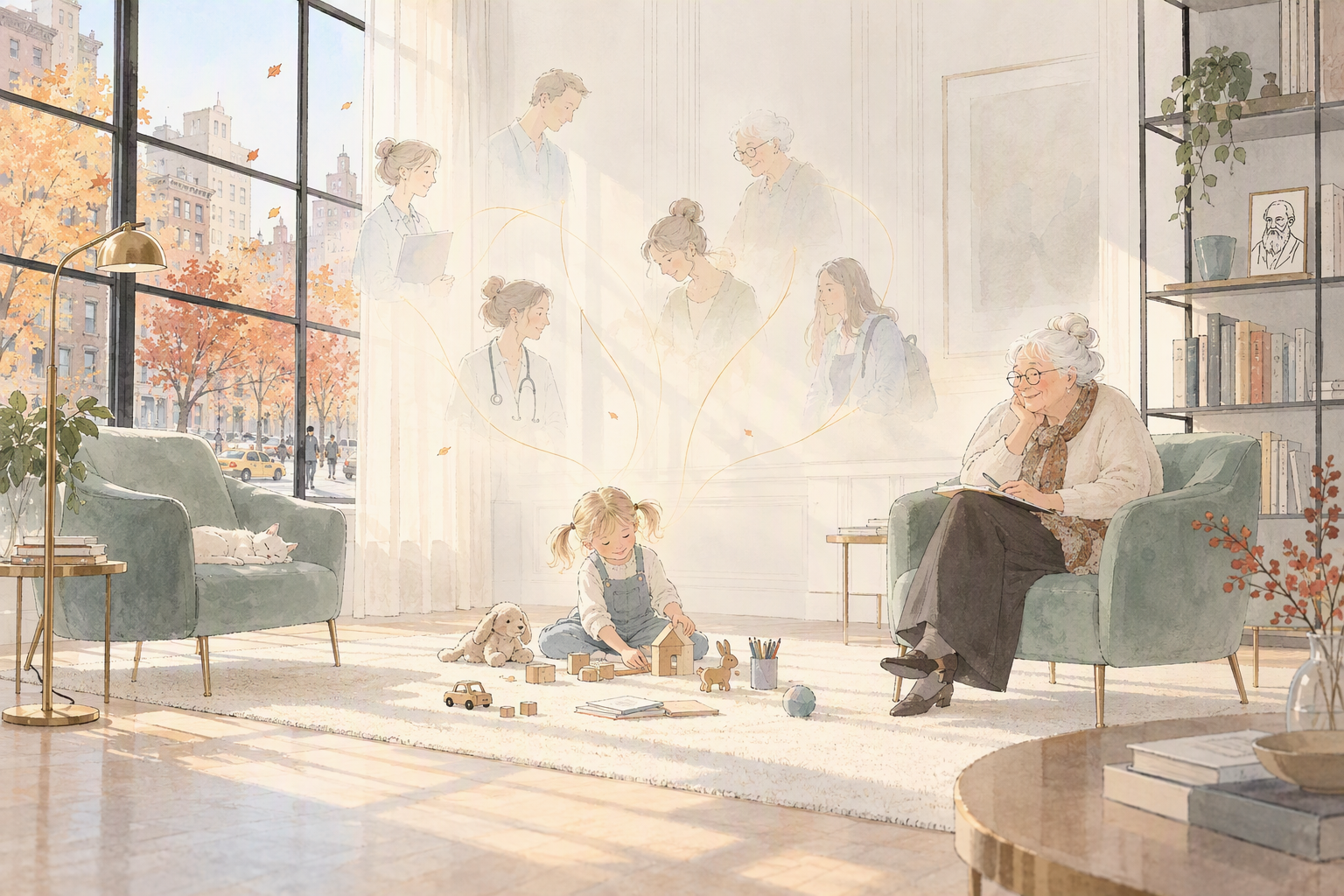
Behind every child who plays, learns, explores, and gradually develops confidence in the world, there is usually a network of people quietly supporting that growth. Parents, of course. But sometimes also teachers, childcare professionals, speech therapists, physicians, psychologists, grandparents, or members of the extended family.
Emotional development is built through relationships.
Before children learn to soothe themselves, someone soothes them. Before they understand what they are feeling, someone helps them put words to their experience. Before they can regulate their emotions on their own, they borrow another person’s capacity to regulate.
These ordinary moments become the foundation of psychological security.
This reality becomes especially visible when parents themselves are going through a vulnerable period.
Illness, grief, migration, separation, financial hardship, emotional exhaustion, or simply isolation can temporarily reduce an adult’s emotional availability, even when their love for their child remains unchanged.
This does not mean that parents are failing.
It simply means that certain moments in life require more support than others.
In my clinical work, I am often struck by the way some children regain their momentum when a network of caring adults comes together around them.
A teacher who welcomes them each morning with consistency.
A childcare professional who notices the earliest signs of distress.
A physician who takes time to listen to a parent’s concerns.
A psychologist who helps make sense of what feels confusing.
A relative who offers a family a few hours of respite.
None of these individuals replaces a parent.
Yet each of them may contribute to creating an environment that feels safe enough for a child to continue growing.
The French psychoanalyst Didier Anzieu used the concept of the “group skin” to describe the way a group can sometimes provide a containing and protective function. It is a powerful image for understanding work with young children.
When family resources are temporarily stretched, a group of professionals, caregivers, and loved ones can form a kind of relational envelope.
Not to replace parents.
But to support them.
To strengthen them.
To help carry what feels too heavy for one person alone.
This reflection becomes particularly important when working with families who have experienced migration.
Moving to a new country often means losing familiar language, social networks, cultural landmarks, and, at times, a sense of belonging. Children must adapt to new expectations while their parents are often adapting as well.
In this context, a family’s native language is far more than a communication tool.
It carries affection, memory, identity, and continuity.
Research increasingly suggests that supporting a child’s home language does not interfere with learning a new one. On the contrary, preserving those linguistic and cultural roots can strengthen family communication, support identity development, and foster the sense of security necessary for learning and growth.
Perhaps this invites us to rethink the way we understand child development.
We often view development as an individual achievement.
In reality, it is first and foremost a relational experience.
A child learns to feel safe because enough people help them feel safe.
A child learns emotional regulation because adults regulate alongside them.
A child develops confidence because caring eyes reflect back the possibility of trusting in their own abilities.
Perhaps this is one of the simplest truths of early childhood.
We become ourselves through the relationships that hold us.
And sometimes, when a family is going through a difficult season, it is these relationships that allow a child to keep growing.
References
Ainsworth, M. D. S., Blehar, M. C., Waters, E., & Wall, S. (1978). Patterns of attachment: A psychological study of the strange situation. Erlbaum.
Anzieu, D. (1985). The skin ego (N. Segal, Trans.). Yale University Press.
Bowlby, J. (1988). A secure base: Parent-child attachment and healthy human development. Basic Books.
Bronfenbrenner, U. (1979). The ecology of human development: Experiments by nature and design. Harvard University Press.
Cyrulnik, B. (2001). Resilience: How your inner strength can set you free from the past. TarcherPerigee.
Werner, E. E., & Smith, R. S. (2001). Journeys from childhood to midlife: Risk, resilience, and recovery. Cornell University Press.