Illness
-
 Marie Nussbaum
 - 20 Nov, 2025
When Checking Becomes Surviving: The Invisible Anxiety Behind Obsessive Rituals
There are patients who come to therapy in a state of profound exhaustion, caught in rituals that have taken hold of their lives. They speak of a fatigue that begins the moment they wake up, of a worry that settles in before the day has even started. They say, “I know it’s irrational, but I can’t stop.” And behind that sentence lie months, sometimes years, of silent struggle. Some check the door several times before leaving home. Others wash their hands until the skin becomes irritated. Still others retrace their steps to make sure the gas is off, the car is locked, that nothing terrible is about to happen. These are not trivial gestures. They are desperate attempts to keep at bay a diffuse fear, a fear without an object, a fear of catastrophe that has no name. A fear that is not real, yet feels as if it were. One patient told me she washed her hands ten times before preparing her children’s meals. She said, “I know my hands are clean, but I’m afraid of giving them something.” That “something” had no shape, no name. It was a floating anxiety, a sense of threat that moved from one object to another. She was not truly afraid of germs. She was afraid of not being a protective enough mother, of letting an invisible danger slip through, of not being equal to what life demanded of her. Washing became a ritual to soothe an old guilt, an overwhelming responsibility, an anxious form of love. Another patient would systematically return to check the door of his apartment. He said, “I know it’s locked, but I’m afraid something will happen if I don’t check.” That “something” had no form either. It was a diffuse worry, a background anxiety looking for a place to land. The door became that place — a scene where anxiety could play itself out without flooding everything else. What often strikes me is the solitude in which these patients live their rituals. They know it makes no sense. They know the door is locked, the faucet is off, the lights are out. They know it intellectually, but their body does not know it. Their body demands another gesture, another verification, another impossible certainty. And it is this impossibility that exhausts them. Clinically, these symptoms rarely appear by chance. They emerge at moments when life shifts: a birth, a loss, a separation, a professional change, a new responsibility. Anthropologists like Mary Douglas have shown how human societies use rituals to contain uncertainty. Obsessive patients create their own rituals to contain an anxiety that overflows. It is not the door they check, nor the hands they wash, but their own capacity to remain standing in a world that feels unstable. Psychoanalysis does not approach these rituals as errors to correct. It listens to them as singular responses to singular histories. Freud (1907/1984) showed that the obsessive subject tries to master a thought or desire they deem dangerous. Winnicott (1965) emphasized the importance of a reliable environment that allows the subject to relinquish omnipotence. Bion (1962), in a more international perspective, described the need to transform raw anxiety into thought. Other traditions, such as the Palo Alto school or the transcultural work of Kleinman (1988), highlight how the body, culture, and social representations shape these rituals. What matters is never to reduce the patient to their symptom. The ritual is only one fragment of their story. One must cross this gesture with everything that surrounds it: losses, responsibilities, identifications, fears, desires, recent or ancient events that have weakened their capacity to contain anxiety otherwise. The symptom is not an enemy to eliminate but a language to decipher. In some cases, the ritual softens when the patient discovers what they were truly trying to check: not the door, not the cleanliness of their hands, but their own solidity. Their capacity to tolerate uncertainty. To accept that not everything can be controlled. To recognize that vulnerability is not a fault. And sometimes, through this patient work, the door stops being a place of threat. The hands stop being a potential danger. The gesture loosens. The body breathes differently. The person discovers they can leave home without returning, cook without washing their hands ten times, walk away from a closed door without needing to touch it again. When that day comes, it is not a victory over the symptom. It is a meeting with oneself. A meeting that depends on the patient’s history, on what they carry, on what they have lived, on what they can symbolize. Nothing is universal. Nothing is mechanical. Everything is singular. And perhaps this is what analytic work ultimately allows: not checking, but self-checking. Not controlling, but understanding. Not reassuring, but transforming. A way of giving the world back some of its fluidity, and the subject some of their freedom. References  Bion, W. R. (1962). Learning from Experience. London: Heinemann. Douglas, M. (1966). Purity and Danger. London: Routledge. Freud, S. (1907/1984). Delusion and Dream in Jensen’s Gradiva. New York: Moffat, Yard. Kleinman, A. (1988). Rethinking Psychiatry: From Cultural Category to Personal Experience. New York: Free Press. Winnicott, D. W. (1965). The Maturational Processes and the Facilitating Environment. London: Hogarth Press.
- Marie Nussbaum
- 01 Apr, 2025
Suffering Bodies, Absent Speech
Eating disorders — anorexia, bulimia, binge eating — raise questions far beyond nutrition or food-related behaviour. They reveal a troubled relationship with the body, self-image, desire, and often, the Other. The question is not simply what the individual eats or refuses to eat, but what this behaviour means to them, what it communicates in their place — sometimes from a buried history that has never been spoken. When speech is obstructed or too painful to express, the body speaks: it mimics, reenacts, substitutes. The eating symptom becomes a gesture of figuration, a way for the subject to become readable where they cannot be heard. Freud described the symptom as a compromise between drive and repression; Lacan reminds us that "the symptom is the trace of a bodily event captured in the order of language." Three Clinical Cases Anastasia (17) comes to therapy at her mother's request, due to her extreme thinness. Intellectually gifted, she rejects all medical concern. A phrase recurs in her speech: "I want to disappear without making noise." She avoids signs of femininity, distrusts bodily transformation, and appears to seek through dietary control a total mastery over her body — and ultimately, over her place in the world. Her emaciated body becomes a symbol of resistance against intrusion, sexualisation, and the gaze of the Other. Anton (24) begins therapy after a breakup that triggers renewed bulimic episodes. He describes alternating between uncontrollable urges and violent rejection as punishment: "I fill myself to hate myself afterward." His family history reveals paternal abandonment and an emotionally preoccupied mother. The unspoken affective void from childhood appears lodged in his body. By reworking the unmet needs of childhood through transference, Anton begins to articulate his experience in terms other than compulsion. Rachel (38) suffers from nighttime binge-eating. In early sessions, she describes her body as "an armor," a means to become invisible, a protection from a world perceived as threatening. Her history is marked by unprocessed traumatic events. The body functions as a projection screen; the eating symptom acts as a numbing agent in response to unspeakable suffering. Through verbalising this buried experience, Rachel begins to reclaim her body — not as a barrier, but as a space of existence. Conclusion Eating disorders cannot be reduced to nutritional concerns or isolated behavioural phenomena. They may be understood as psychic expressions where speech fails — incomplete attempts to give shape to subjective suffering. Each patient engages with the symptom in a unique way, grounded in their personal history. Psychoanalysis does not aim to erase the symptom but to elaborate it. It offers a space of listening where the symptom can be narrated, linked to intimate experience, and gradually re-integrated into a process of subjectivation. The body thereby shifts from being a passive object to a symbolic medium. The subject can then reclaim their story — not through repetition or mastery, but through speech, meaning, and encounter.
- Marie Nussbaum
- 01 Jun, 2024
Overcoming What?
As caregivers, can we truly talk about fighting against a disease or an emotion? Often, we hear or see posters using this term in the context of battling autism, cystic fibrosis, cancer, or diabetes. On a smaller scale, we hear it in speeches addressing fears or loneliness. Does this warrior-like language not contribute to a dichotomous view of the world, dividing the strong and the weak, the winners and the losers, the survivors and the deceased? Can such rhetoric imprison illness or emotion in a binary narrative, where those who succumb are perceived as having fought poorly? It would imply that courage can be measured, endurance quantified, and that death, in the most severe cases, represents failure. The inability to overcome one's fears or loneliness would then be solely attributed to the individual, without considering their context, history, and what their symptom reveals. For example, must cancer or diabetes only be perceived as a war against an external adversary seeking to annihilate the patient? Could it also represent a part of oneself that has gone astray, a defect within oneself? Naturally, this does not mean one should submit to it, but it is important to view this transformation for what it is: a brutal upheaval that requires reevaluation. The real question would be to think of the symptom as something that does not define the person in their entirety, but as a testimony, a call initiating questioning. It would then be a matter of knowing how to coexist with this part of oneself in imbalance while continuing to move forward. Are illness or emotion immutable, or can health and well-being be reimagined otherwise? Not as a return to the previous state, but as a newfound serenity, a capacity to face uncertainty without being entirely defined by it. Health then becomes a way of being, a balance that does not depend on organic or emotional perfection but on the calmness of the mind and faith in the future — or at least giving meaning to something that sometimes appears abruptly in our lives. Illness often represents to our patient a defect of something, a sudden rupture in the natural course of events, a crack in our daily sense of security. It destroys our illusion of constancy and confronts us with a reality that sometimes defies initial logic. However, at the heart of what may seem like absurdity, there lies a freedom: the freedom to determine how to live with this new reality, to understand it in order to move forward. These trials and upheavals do not define us. It is essential to delve into the details of life, to linger on those suspended moments where everything changes silently. After the collapse, one learns to walk towards oneself again, sometimes with the slowness of those who relearn or discover something intimate — to come out stronger. Thus, without being a victory, it becomes part of an affirmed and meaningful life story.

When a Child Seeks Their Own Path: Understanding Without Confining
In my consultation, parents sometimes arrive with a word already placed upon their child: autism, ADHD, “behavioral disorder.” Sometimes suggested by school, sometimes by a hurried professional, sometimes born from an anxiety that has grown too large. They arrive with this word as one arrives with an explanation that reassures as much as it unsettles. They are trying to understand what, in their five‑ or seven‑year‑old child, resists, overflows, withdraws, opposes, or agitates. But at this age, not everything that resembles autism is autism. And not everything that resembles a disorder is one. Frances Tustin wrote that true autism is rooted in a particular way of perceiving the world, often from the earliest years of life, as if sensory experience itself became overwhelming. Meltzer described a difficulty in transforming raw experience into representation. Geneviève Haag spoke of children engaged in a silent struggle to maintain a fragile internal cohesion. These descriptions do not apply to all children who oppose, who move constantly, who dream, who withdraw, or who struggle to adapt to school. Some children, very lively, very sensitive, very reactive, may evoke what is sometimes associated with ADHD. But René Misès reminded us that agitation can be a language, a way of expressing discomfort, fear, fatigue, or even boredom. A child who moves constantly is not necessarily “hyperactive.” He may be a child trying to regulate himself, to reassure himself, to feel alive in a world that moves too fast for him. Other children, more solitary, more absorbed in their interests, more sensitive to routines, may evoke traits sometimes associated with discreet autistic profiles. But again, caution is essential. Some children are simply very observant, very focused, very introverted. They love details, precise universes, rituals that soothe them. Daniel Stern reminded us that each child builds their inner world in their own way, and that this way is never a disorder in itself. Serge Lebovici emphasized the importance of understanding the child within their context, their history, their relationships. Didier Houzel described parenthood as a living space, sometimes fragile, sometimes wounded, but always transformable. Winnicott reminded us that a child can only develop if they find a sufficiently good environment, capable of holding them without overwhelming them. In this landscape, words circulate quickly. They sometimes reassure, because they give shape. They sometimes worry, because they freeze. They can become an involuntary way of stepping back from what the child is trying to express. As if the word were enough. As if it explained everything. As if it relieved us from meeting the child in their singularity. A five‑ or seven‑year‑old child does not express their distress with words. They express it with their body, their behavior, their refusals, their anger, their silences. Sometimes through agitation, sometimes through withdrawal, sometimes through opposition. They express it as they can. And it is up to us, adults, to help translate that language. Sometimes a child seems to have a cork in their mouth. Something that prevents them from speaking, thinking, symbolizing. That cork may be fear, anxiety, school difficulty, family tension, hypersensitivity, emotional immaturity, or a fragile bond. It is not always a neurodevelopmental disorder. It is not always a diagnosis. It is often an enigma. Supporting the child means unfolding that enigma. Meeting them where they are. Observing them play, draw, invent, hide, return. Play, as Winnicott wrote, is the first space of care. It is where the child shows what they cannot say. It is where they replay their fears, their conflicts, their desires. It is where they invite us, sometimes timidly, into their world. Support is always a team effort. Psychologists, child psychiatrists, teachers, educators, speech therapists, psychomotor therapists — each brings a piece of the puzzle. None holds the truth. All try to understand. All try to support the child’s development, whatever name — or no name — is eventually placed on their difficulties. For parents, the task is immense. They must learn to look at their child differently, to hear what they are trying to express, to not be crushed by words that circulate too quickly. They must accept that a diagnosis, if it comes one day, will never be an end but a beginning. They must be supported, accompanied, recognized in their doubts, fears, and exhaustion. A child is never a disorder. A child is a subject in becoming. A subject seeking their place. A subject who sometimes bumps against the world. A subject who always deserves to be met with time and care. REFERENCES  Dolto, F. (1985). When the Child Appears. Paris: Gallimard. Haag, G. (2000). The Autistic Child: The Baby and the Mother. Paris: PUF. Houzel, D. (1999). The Stakes of Parenthood. Paris: PUF. Lebovici, S. (1983). The Infant, the Mother and the Psychoanalyst. Paris: Bayard. Meltzer, D. (1975). Explorations in Autism. Perthshire: Clunie Press.
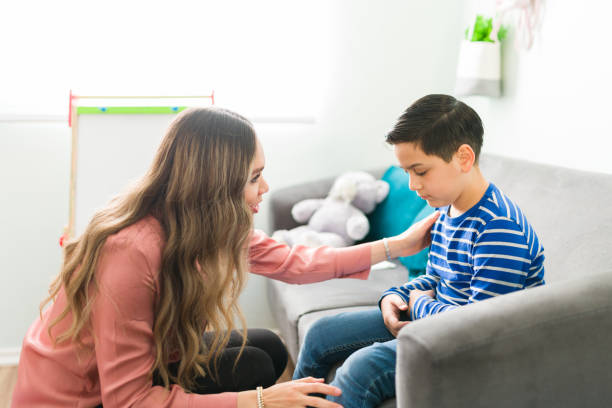
When the Unthinkable Strikes: How to Speak to a Child About Another Child’s Critical Illness
One morning, a friend called me, his voice trembling. He had just learned that the child of close friends — a three‑year‑old with whom his own daughters had played only days earlier — had been placed in an induced coma. A sudden illness, first mistaken for a simple infection, had turned into a life‑threatening emergency. The child could no longer breathe on his own. Doctors were trying to keep him alive. The outcome remained uncertain. My friends were in shock. Shaken for this child, for his parents, and also for their three daughters aged four, nine, and eleven. How could they speak to their children about what was happening? How could they express sadness, fear, and shock — without collapsing, without overwhelming them, but without lying either? How could they accompany this inner tremor that moves through adults and that children, at any age, always perceive, even when nothing has yet been said? Some news makes the ground shift. It reminds us that life can change in a breath. It also reminds us that death is not an abstract idea: it is the only certainty of our existence. We do not know where we will live, whom we will love, how many children we will have, or what we will become. But we know this: we will all die one day. And children encounter this truth sooner or later — sometimes too soon. Parents then search for words that do not betray reality, nor the child, nor their own emotional truth. A child does not need perfect explanations; a child needs a truthful presence. For the youngest, four years old, I suggested to my friend that she might become more tearful, more irritable, more clingy than usual. At that age, a child does not conceptualize death; she feels it. She senses that something trembles in the air, in the bodies of adults, in the house. She does not understand what is happening, but she perceives that something is happening. As Dolto reminds us, the child “knows everything, but does not understand everything.” Naming emotions rather than concepts can help: “You’re sad? You’re worried? You feel that we are upset? That’s normal. We are sad too.” At this age, death is not irreversible. The child may believe one returns from death as from a trip. A simple formulation may be enough: “He is very sick. The doctors are trying to help him. We don’t yet know what will happen.” And it can be helpful to distinguish the hospital from death: the hospital is a place of care, not a place where people die. It is at the cemetery that we accompany the dead. This distinction protects the child from unnecessary fears. For the nine‑year‑old, questions become more precise. Between eight and ten, the child enters what Piaget called the stage of concrete operations: she understands irreversibility, causality, temporality. She knows death exists, that it is final, that it can affect children. She may ask: “Is he going to die?” “Do children die?” “Can it happen to us?” At this age, the child seeks truth, but a truth that does not crush. As Maria Nagy showed, death becomes a biological reality, but the child still needs symbolic protection. A nuanced response might be: “Yes, sometimes children die. It is rare, but it happens. The doctors are doing everything they can. We don’t yet know what will happen. We are sad and worried, but we are together.” The child may also wonder about contagion or responsibility: “Did we give him something?” “Is it our fault?” A clarification can soothe: “It is no one’s fault. You cannot catch what he has by playing. You did nothing wrong.” Children of this age are often helped by rituals. Rituals soothe, contain, symbolize. They allow one to do something when nothing can be done. Lighting a candle. Drawing a picture. Saying a prayer. Thinking of the sick child together. Sending a symbolic message. As Indian psychoanalyst Sudhir Kakar reminds us, rituals are “cultural containers” that transform raw anxiety into thought. For the eldest, eleven, understanding is closer to that of an adolescent. She can grasp the gravity, the injustice, the absurdity. She may feel anger toward the world, the doctors, God, or chance. She may also feel guilty for being healthy, for being alive, for having laughed while the other child suffered. At this age, a truthful presence can support her: “We are very sad. We are afraid. We hope. We are thinking of him.” And leaving room for her own words, her own silences. As Yalom notes, the confrontation with death — even indirectly — opens deep existential questions. The child must feel she can ask them, without having to carry those of the adults. And then there are children with specific needs: cognitive difficulties, developmental disorders, sensory particularities, more fragmented psychic organization, different internal temporality. For them, the announcement cannot be the same. Understanding serious illness or death depends not only on age, but also on symbolic capacities, emotional maturity, relationship to reality, and the way the child thinks — or struggles to think. The work of Peter Hobson, Vikram Patel, and the team at the Montreal Children’s Hospital shows that these children may integrate information more slowly, react later — sometimes weeks or months later — express worry through behavior rather than words, ask repetitive questions to tame the idea, or show diffuse anxiety without apparent link. With them, simple, concrete words without metaphors may be more accessible. Repeating, observing, welcoming can be helpful. The question may arise late, in the middle of a game, a drawing, a silence. And when the child finally finds the opening to ask: “Where is the little boy?” being available at that moment can make all the difference. The absence of immediate reaction does not mean absence of thought. In some children, thought builds slowly, in fragments. The question may arise long after the event. Children do not need to know everything. They need to know you are there. That you hold. That you are sad, but present. That you hope, even in uncertainty. That you can think together about this child without being overwhelmed. And if the child asks: “Do children die?” A gentle and truthful response might be: “Yes, sometimes. But it is rare. And when a child is very sick, doctors do everything they can. We don’t yet know what will happen. We are sad, but we are together.” Accompanying a child in such moments is teaching this: Life is fragile. Death exists. But we do not face what frightens us alone. References  Bowlby, J. (1980). Attachment and Loss: Vol. 3. Loss. Basic Books. Dolto, F. (1985). Lorsque l’enfant paraît. Gallimard. Hobson, P. (2002). The Cradle of Thought. Macmillan. Kakar, S. (1991). The Inner World: A Psychoanalytic Study of Childhood and Society in India. Oxford University Press. Nagy, M. (1948). The child’s theories concerning death. Journal of Genetic Psychology, 73(1), 3–27. Patel, V. (2018). The Lancet Commission on Global Mental Health and Sustainable Development. The Lancet. Piaget, J. (1976). La formation du symbole chez l’enfant. Delachaux & Niestlé. Worden, J. W. (1996). Children and grief: When a parent dies. Guilford Press. Yalom, I. (1980). Existential Psychotherapy. Basic Books. Winnicott, D. W. (1971). Playing and Reality. Tavistock Publications.