Paper Warriors: Narcissism, Querulousness and Paranoia in the Consulting Room
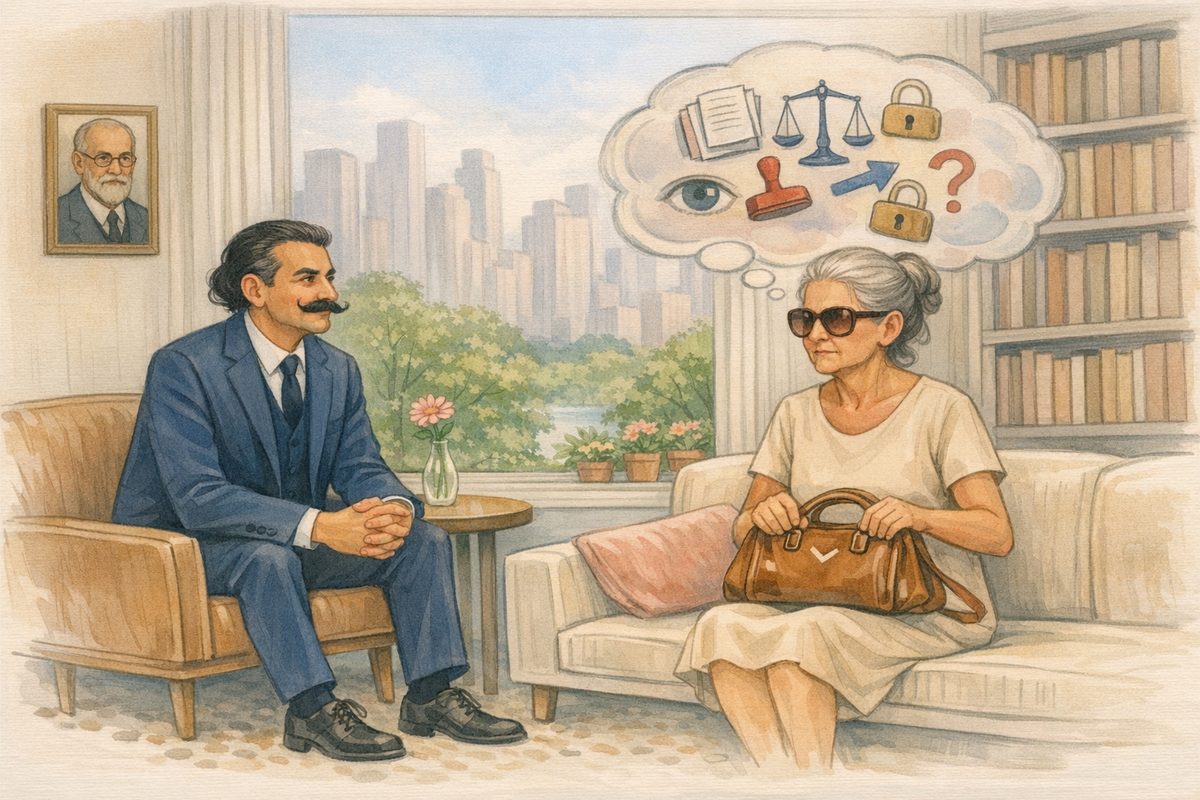
There are patients who do not enter therapy the way one enters a place of care, but as one steps into a neutral zone after years of battle. They do not come seeking relief, but a breath. They do not come to understand, but because loneliness, thickening over time, has become a greater threat than their real or imagined enemies. They seek help rarely, and late, often when professional alliances fracture, when loved ones withdraw, when the inner war begins to cost more than the impossible peace. And when they cross the threshold, there is something in their gaze of the fatigue of sentinels who have never stopped keeping watch.
I always feel a deep empathy for these patients. Their suffering is real, even when it appears as anger, certainty, or procedure. They are not difficult: they are wounded. They are not rigid: they are frightened. They are not litigious by nature: they are trying to survive. And it takes great delicacy to approach this suffering without brusqueness, without naming it too quickly, without reducing it to a diagnosis.
The DSM‑5 distinguishes several patterns that may look similar in daily life but differ profoundly in their psychic architecture. Belligerent narcissism is not paranoia: the former attacks to avoid humiliation, the latter defends against a threat it believes real. Querulousness is not paranoid personality disorder: it is a fixation on juridical reparation, often linked to narcissistic injury or an impossible mourning. Obsessional procedural profiles are neither paranoid nor narcissistic: they become trapped in procedure because it offers structure, mastery, and an illusion of control over anxiety.
There is, in fact, a wide variety of psychiatric conditions or borderline states that may resemble these profiles without overlapping entirely: paranoid, narcissistic or obsessive‑compulsive personality disorders, persecutory‑type delusional disorders, attenuated psychotic states, complex trauma where hypervigilance becomes a way of being. Distinguishing them requires time, nuance, and patient listening. Nothing is ever fixed: the patient’s history, personality structure, traumas, losses, and old loyalties shape infinite variations. Two patients who look similar on the surface may be driven by entirely different forces underneath.
Paranoia is particular in that it often emerges in adulthood, sometimes after a triggering event, sometimes without apparent cause. It builds itself like a logical, solid, coherent architecture, but founded on a false premise. The person does not doubt: they know. And this knowledge protects them from an inner collapse they could not withstand. Loved ones experience it as a constant tension: every word can become evidence, every silence an attack, every nuance a betrayal.
Contemporary culture has made these patterns visible worldwide through fiction. Travis Bickle in Taxi Driver, whose loneliness becomes a persecutory interpretative system. Michael Corleone in The Godfather, whose extreme vigilance isolates his entire family. Erik Killmonger in Black Panther, whose historical and personal wound hardens into an absolute quest for justice. Severus Snape in Harry Potter, whose obsessive loyalty and chronic mistrust form a complex pattern of rigidity, secrecy, and hypervigilance. These figures are not clinical models, but they reveal how suffering can harden into a system.
Reality is more subtle. A querulous mother may arrive with binders stacked like shields. She is not trying to convince: she is trying not to collapse. A man with a paranoid functioning may analyse every detail of the session, not to manipulate, but because vigilance has become his second skin. A security officer may check his own office door three times, not out of obsession, but because threat has become an inner presence. A political leader may speak as if issuing a communiqué, never letting a crack show, because vulnerability has always been costly.
These patients can be extraordinary in professions where vigilance, determination, the ability to detect flaws and anticipate danger become strengths: spies whose survival depends on hypervigilance, security leaders who perceive what others overlook, statesmen or activists whose devotion to a cause requires exceptional mental endurance, historical figures whose absolute determination changed the course of events, though their family life often bore the cost of such devotion.
Historical literature evokes, for instance, the moral rigidity and growing mistrust of Malcolm X in the last years of his life, or the psychic solitude of certain revolutionary leaders who, through vigilance, ended up unable to trust anyone. These examples are not meant to diagnose the living, but to remind us that these patterns can be strengths in public life and burdens in private life.
The question of justice often returns. Querulous patients want justice to be done. But what they seek, in truth, may be fairness: an inner recognition, a meaning‑making, a symbolic repair. Justice is an external act; fairness is an inner movement. Justice is won against someone; fairness is won with oneself. The literature is cautious here. Some authors suggest that symbolisation may soothe querulousness, but nothing is guaranteed. It is a fragile, uncertain terrain. For my part, I believe (or hope) that when pain can be put into words, it sometimes stops seeking a courtroom. It is a clinical intuition, not a theoretical certainty. A way of accompanying, not a promise.
Families often live in a mixture of loyalty and exhaustion. They learn to avoid sensitive topics, to sidestep anger, to anticipate interpretations. They love someone who cannot trust. They try to remain fair in front of someone who seeks justice. They exhaust themselves maintaining a bond that sometimes shrinks to a thread.
For children, growing up with a parent who lives in vigilance, procedure, or certainty can be disorienting. They learn too early to measure their words, anticipate reactions, avoid conflict. Some become experts in emotional diplomacy; others withdraw; others exhaust themselves trying to repair what was never theirs to fix. Therapy can then become a place where the child, now an adult, can lay down what they carried too long, understand that this parent was not harsh but suffering, and that their own life can be built differently.
The consulting room is not a courtroom, nor a battlefield, nor an expert’s office. It is a place where one learns to live with one’s shadows without turning them into enemies. A place where strength is found not in certainty but in the capacity to doubt. A place where inner justice is not won against someone but with oneself. And sometimes, that is enough for the war to end, not in the world, but in the psyche of the one who carried it, allowing these paper warriors to lay down their weapons a little.
References
American Psychiatric Association. (2013). Diagnostic and Statistical Manual of Mental Disorders (5th ed.). Washington, DC: Author. Daudet, A. (1897). Correspondance. Paris: Fasquelle. Freud, S. (1958). Psycho-analytic notes on an autobiographical account of a case of paranoia (Dementia paranoides). In Standard Edition (Vol. 12). (Original work published 1911). Kretschmer, E. (1974). Der sensitive Beziehungswahn. Berlin: Springer. (Original work published 1918). Starobinski, J. (1957). La transparence et l’obstacle: Essai sur Rousseau. Paris: Gallimard. Targowla, R. (1993). La quérulence. Paris: PUF. Weinstein, E. (1981). Woodrow Wilson: A Medical and Psychological Biography. Princeton University Press.