Growing Old Together: When Bodies Fall Out of Sync and the Bond Must Be Rewritten
-
 Marie Nussbaum
 - 12 Aug, 2025
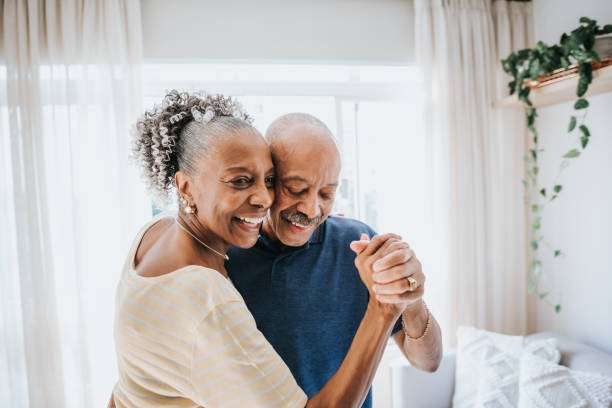
Growing old together is not a simple continuation of what came before. In some couples who have shared a lifetime side by side, something begins to shift almost imperceptibly. The years have settled like thin layers of sediment, the children have grown, grandchildren bring their joyful turbulence, and retirement has become a familiar landscape. One might imagine that everything is stable, that the bond has crystallized into a quiet certainty. Yet around seventy for her, a little later for him, a subtle disturbance sometimes appears, like a change in the internal weather.
She notices a new irritability, a tension that does not belong to their shared history. He perceives in her a heightened sensitivity, a different way of inhabiting the everyday. Nothing dramatic. Rather a delicate displacement, a silent rearrangement of psychic positions. As if, after so many seasons lived together, the couple still had to learn how to readjust.
Menopause, for her, is long behind, yet its symbolic effects continue to unfold. Simone de Beauvoir showed how women often enter old age earlier, not only through the body but through the social gaze, which anticipates and imposes transformation before biology does. She has already encountered the question of aging, of loss, of reinvention.
Andropause, for him, arrives later, more slowly, almost clandestinely. It sometimes manifests as diffuse irritability, reduced tolerance, a heightened sensitivity to frustration. As if the male body, long supported by a fiction of continuity, were suddenly reminded of its finitude. George Vaillant’s work on male aging highlights how this period can unsettle self-esteem, awaken old anxieties, or reactivate defenses that once served well.
In this temporal gap, something is replayed. She has already crossed her hormonal storms, already renegotiated her symbolic place. He is only beginning to face his. And in this slight desynchronization, the couple must compose a new scene, one in which each must relinquish a part of who they believed themselves to be.
Irvin Yalom wrote that long-term couples are “laboratories of existence,” where the great human questions—freedom, solitude, death, meaning—are continually revisited. At this age, these questions cease to be abstract. They become tangible. They slip into daily gestures, silences, irritations.
From a psychoanalytic perspective, the real of the body returns. Lacan emphasized that the body is never merely an organism: it is a site of jouissance, loss, and lack—an unpredictable partner that resists mastery. At eighty, this real asserts itself. And this partner cannot be seduced, convinced, or controlled. One must negotiate with it.
Freud, in On Transience, reminded us that the fragility of what we love—its perishability—can intensify attachment as much as it threatens it. Growing old together means feeling time become palpable, giving the bond a new gravity.
The irritability of the aging partner is not only biological. It can be a defense against the terror of vulnerability, a way to keep at bay the fear of falling, of dependence, of disappearance. Erik Erikson described the final stage of life as a fragile balance between integrity and despair—an inner work where irritability may mask deeper unease.
She, for her part, oscillates between patience and fatigue. She may have gained inner freedom as physical strength diminished. She can welcome, but she can also tire. What unfolds here is not only hormonal or physiological: it is a redistribution of roles, a rewriting of the conjugal pact.
Some couples find in this period a new tenderness, a complicity freed from performance. Others see old wounds resurface, long-muted frustrations reappear. Time, as it advances, reveals the fault lines. Laura Carstensen’s socioemotional selectivity theory shows that older adults tend to prioritize essential bonds and authentic emotions, which can intensify both gentleness and tension.
And yet, there is in these aging couples a singular strength: that of those who have weathered storms together—births, losses, departures, returns. A strength that is not spoken, but visible in the way they sometimes still look at each other, as if despite everything, despite irritations, despite bodies that resist, something holds.
Winnicott spoke of the capacity to be alone in the presence of another. Perhaps this is what mature love becomes: a peaceful coexistence, where each can be themselves without the other becoming a threat. A way of inhabiting time together, without seeking to correct, convince, or transform.
At seventy, at eighty, the couple is no longer a project. It is a work. A living, fragile, sometimes rough work, but profoundly human. And within this humanity, there is still movement, desire, conflict, care. There is still life.
References
Baltes, P. B., & Baltes, M. M. (1990). Successful aging. Cambridge University Press. Beauvoir, S. de. (1970). Old age. Gallimard. Carstensen, L. L. (2011). A long bright future. PublicAffairs. Cohen, G. D. (2005). The mature mind: The positive power of the aging brain. Basic Books. Erikson, E. H. (1997). The life cycle completed. W. W. Norton. Freud, S. (1915). On transience. In Standard Edition (Vol. 14). Lacan, J. (1975). The seminar, Book XX: Encore. Seuil. Vaillant, G. (2002). Aging well. Little, Brown and Company. Winnicott, D. W. (1958). The capacity to be alone. International Journal of Psychoanalysis, 39, 416–420. Yalom, I. D. (2008). Staring at the sun: Overcoming the terror of death. Jossey-Bass.