When Art Heals: Creativity, Psychosis, Sublimation, and Mental Health
Art has accompanied humanity for thousands of years. Long before psychology and neuroscience sought to understand the mechanisms of psychological suffering, human beings painted, sculpted, wrote poetry, danced, sang, and told stories in an effort to give form to what lived within them. From the beginning, artistic creation appears to have answered a profoundly human need: to make the invisible visible, to share what cannot easily be spoken, and to transform inner experience into something that can be observed, contemplated, and communicated.
Contemporary research increasingly confirms what artists have often sensed intuitively. Artistic practices can contribute to psychological well-being, emotional regulation, resilience, and quality of life. The landmark report published by the World Health Organization in 2019, based on more than 3,000 studies, highlights the potential role of the arts in health promotion, disease prevention, and support for individuals facing a wide range of physical and psychological challenges.
Perhaps the therapeutic power of art lies in the fact that some human experiences exceed the limits of ordinary language. Grief, trauma, loneliness, exile, anxiety, melancholy, and certain intense psychological states often resist immediate verbal expression. Images, colors, sounds, forms, and metaphors may offer alternative pathways through which experience can be expressed long before it can be fully understood.
This intuition lies at the heart of art therapy. Contrary to popular belief, art therapy is not primarily concerned with producing beautiful artwork. Rather, it uses the creative process within a therapeutic setting to facilitate the exploration of emotions, internal conflicts, memories, and aspects of identity that may be difficult to access through words alone. The artwork itself is often less important than the psychological movement it makes possible.
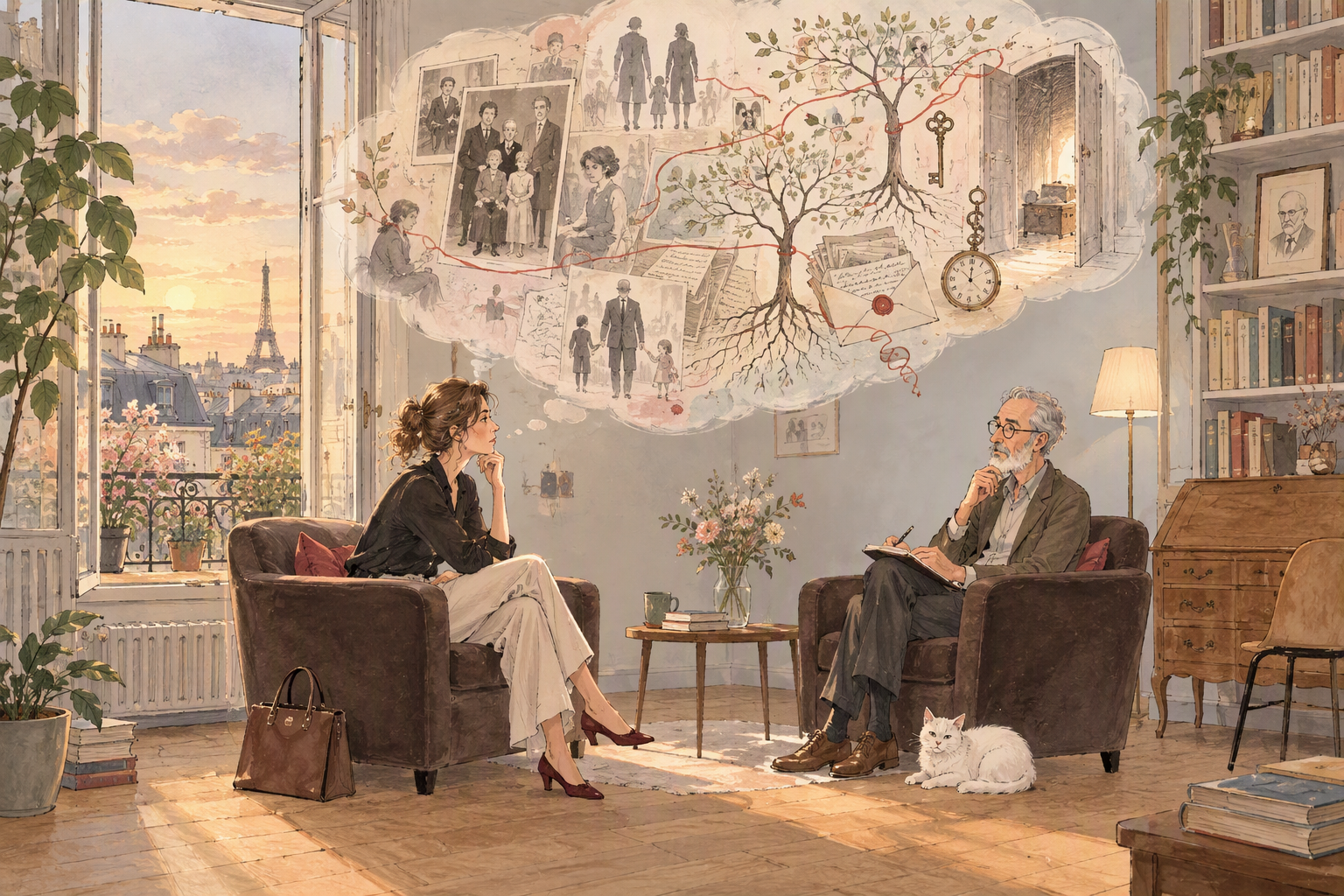
In clinical practice, some individuals describe a distinctive experience: a sense of relief that emerges when an emotion, thought, or internal image finally acquires an external form. The suffering does not disappear. Yet it is no longer entirely contained within the person. A drawing, sculpture, poem, or piece of music can become an intermediate space where difficult experiences are deposited, observed, and gradually transformed.
This process echoes the psychoanalytic concept of sublimation. Freud proposed that certain psychological tensions and conflicts may be transformed into socially valued forms of creativity, intellectual work, or cultural achievement. Suffering is neither denied nor eliminated. Instead, it is given another form. It becomes thought, literature, science, music, or art. Sublimation is neither automatic nor guaranteed. Not every wound produces a masterpiece, and not every work of art emerges from suffering. Yet the history of culture repeatedly illustrates humanity’s remarkable capacity to transform difficulty into creation.
Freud himself was fascinated by Michelangelo. In his famous essay on the sculptor’s Moses, he reflected on the emotional force contained within the work. What captivated him was not merely technical mastery but the way powerful emotion appeared held within the sculpture itself. Moses is not depicted in the midst of rage. He is shown restraining it. An impulse becomes reflection. An emotion becomes form. The sculpture captures an intensely human moment in which passion is transformed rather than discharged.
Poetry reveals a similar process. In The Flowers of Evil, Charles Baudelaire transformed melancholy, longing, contradiction, desire, and suffering into artistic language. He did not attempt to erase pain or explain it away. Instead, he gave it shape. The deeply personal became universal. More than a century and a half later, readers continue to find themselves reflected in experiences they never personally lived.
This capacity to transform emotional experience appears throughout the history of art. Vincent van Gogh remains one of the figures most frequently associated with psychological suffering. His letters reveal periods of profound loneliness, uncertainty, and emotional distress. Yet reducing his work to illness would be profoundly misleading. Painting was not simply a reflection of his suffering. It was also an effort to organize experience, to create meaning, and to maintain a relationship with the world during periods when that relationship seemed threatened.
Frida Kahlo transformed chronic physical pain, personal loss, and emotional hardship into an artistic language of exceptional symbolic richness. Edvard Munch’s The Scream remains one of the most powerful visual representations of existential anxiety ever created. In each case, the artwork does not eliminate suffering. It renders it communicable. It transforms an intimate experience into something that can be shared with others.
The relationship between psychosis and creativity requires particular caution. For many years, cultural narratives romanticized the link between madness and artistic genius. Contemporary research encourages a more nuanced perspective. There is no evidence that psychosis produces creativity, nor that creativity should be understood as a sign of psychopathology. Nevertheless, some individuals living with psychotic experiences turn to artistic expression as a way of representing what they are going through. Artistic creation may, in certain cases, provide a space in which delusional experiences can be represented and symbolized, allowing aspects of those experiences to become more understandable and psychologically workable. The goal is not the disappearance of delusional thinking but the possibility that some experiences become less isolating and more capable of being reflected upon.
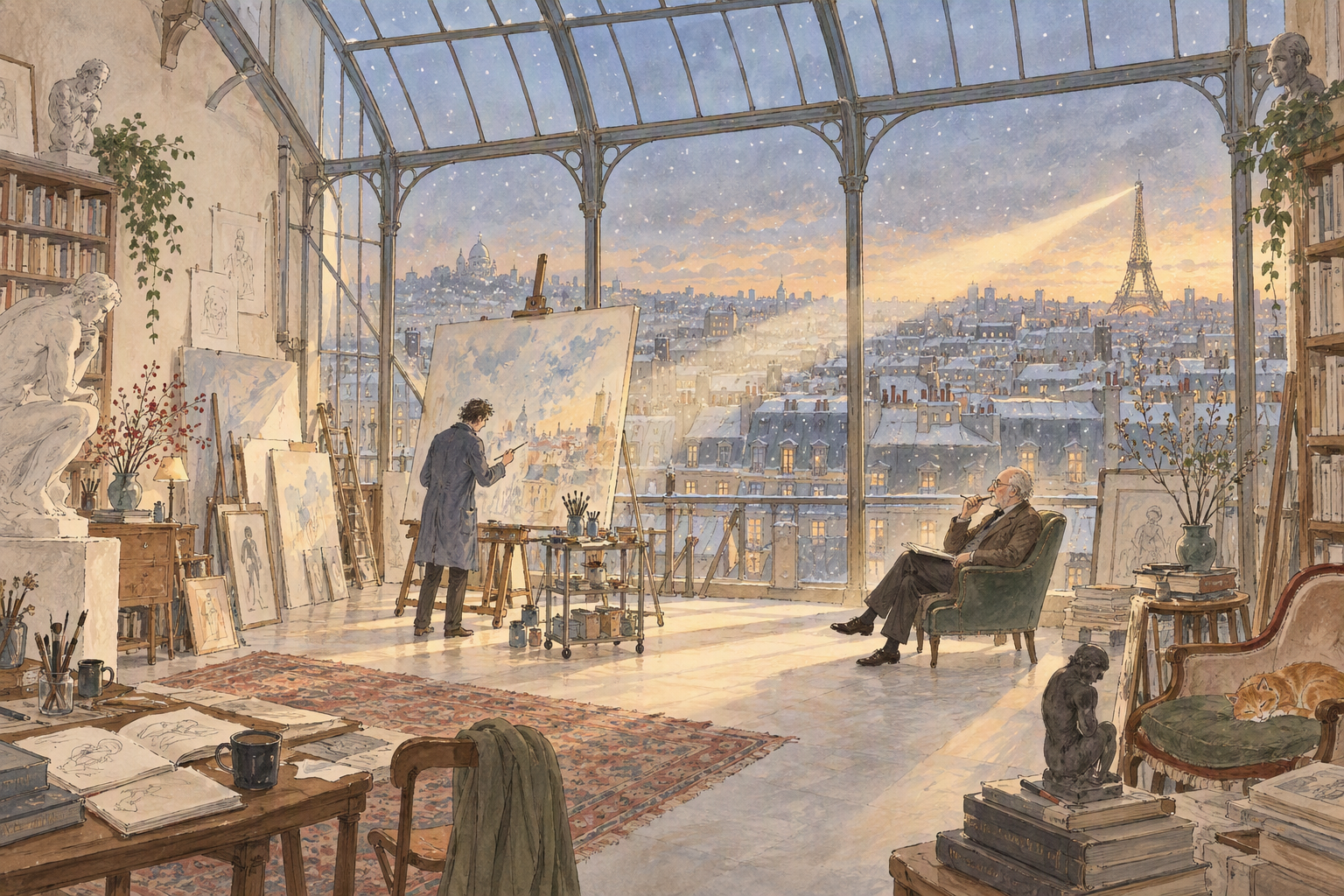
I sometimes imagine what it might have been like if a sculptor of Rodin’s stature were to walk into a contemporary psychotherapy office in Paris. Not Rodin himself, but someone resembling him: a man overwhelmed by relentless images, driven by creative urgency, unable to fully quiet his mind. Over time, one observation might emerge with increasing clarity. Whenever he worked with stone or clay, something settled. Not because his conflicts disappeared, but because they acquired form. Marble became a silent interlocutor. The sculpted figure held what words could not contain. This imaginary vignette inevitably evokes the story of Camille Claudel and Auguste Rodin, a relationship memorably portrayed in the film Camille Claudel starring Isabelle Adjani and Gérard Depardieu. Regardless of historical or psychiatric interpretations, their story reminds us that artistic creation may sometimes represent an attempt to survive emotionally intense experiences.
The psychoanalyst Wilfred Bion offers another perspective on the creative process. He emphasized what he called negative capability, borrowing the expression from the poet John Keats. Negative capability refers to the capacity to tolerate uncertainty, ambiguity, and not knowing without rushing toward premature explanations. Creativity often requires precisely this disposition. A painter does not always know where a painting will lead. A poet does not know the final line when writing the first. A sculptor gradually discovers what the material itself seems to reveal. Both artistic creation and psychotherapy require the ability to remain open to what has not yet taken shape.
This idea resonates deeply with the work of Donald Winnicott. For Winnicott, creativity is not reserved for artists. Rather, it represents one of the essential signs of a psychologically alive existence. To live creatively means to engage with reality in a personal and authentic way. It means preserving the capacity to transform experience rather than merely endure it.
Art does not replace psychiatry, psychotherapy, or medical treatment when such interventions are needed. Yet it offers something uniquely human. It creates a space in which what once seemed unspeakable can become representable. It transforms raw experience into image, movement, narrative, or symbol. It does not remove suffering. It may, however, help make suffering more bearable.
Perhaps this is why the works of Michelangelo, Baudelaire, Van Gogh, Frida Kahlo, Munch, Rodin, and Camille Claudel continue to move us today. They remind us that vulnerability is not always the opposite of creativity. Sometimes it becomes its source. And under certain circumstances, creating is not merely the production of an artwork. It is a profoundly human way of remaining alive.
References
American Psychiatric Association. (2022). Diagnostic and Statistical Manual of Mental Disorders (5th ed., text rev.; DSM-5-TR). American Psychiatric Publishing.
Bion, W. R. (1962). Learning from Experience. Heinemann.
Bion, W. R. (1970). Attention and Interpretation. Tavistock.
Fancourt, D., & Finn, S. (2019). What Is the Evidence on the Role of the Arts in Improving Health and Well-Being? A Scoping Review. World Health Organization Regional Office for Europe.
Freud, S. (1908/1959). Creative Writers and Day-Dreaming. In J. Strachey (Ed. & Trans.), The Standard Edition of the Complete Psychological Works of Sigmund Freud (Vol. 9, pp. 141-153). Hogarth Press.
Freud, S. (1914/1955). The Moses of Michelangelo. In J. Strachey (Ed. & Trans.), The Standard Edition of the Complete Psychological Works of Sigmund Freud (Vol. 13, pp. 211-238). Hogarth Press.
Kapitan, L. (2018). Introduction to Art Therapy Research (2nd ed.). Routledge.
Malchiodi, C. A. (2020). Trauma and Expressive Arts Therapy: Brain, Body, and Imagination in the Healing Process. Guilford Press.
Schaverien, J. (1992). The Revealing Image: Analytical Art Psychotherapy in Theory and Practice. Routledge.
Stuckey, H. L., & Nobel, J. (2010). The Connection Between Art, Healing, and Public Health: A Review of Current Literature. American Journal of Public Health, 100(2), 254-263.
Van Lith, T. (2016). Art Therapy in Mental Health: A Systematic Review of Approaches and Practices. The Arts in Psychotherapy, 47, 9-22.
Winnicott, D. W. (1971). Playing and Reality. Tavistock.
World Health Organization Regional Office for Europe. (2019). What Is the Evidence on the Role of the Arts in Improving Health and Well-Being? A Scoping Review. World Health Organization.